柜
Character Story & Explanation
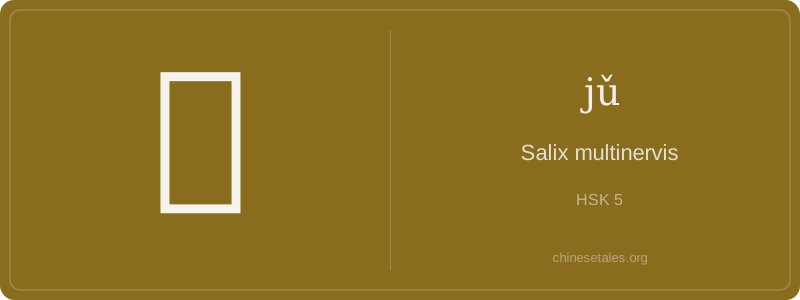
The earliest form of 柜 appears not in oracle bones but in seal script (around 300 BCE), where it was written as 木 + 巨 — literally 'tree' plus 'huge'. But don’t be fooled: the 'huge' component wasn’t about size. In ancient phonetic loan usage, 巨 (jù) was borrowed for its sound to represent *kʷrəʔ, an early word for willow-like trees with broad leaves and prominent veins. The left-side 木 (wood/tree) radical anchors it firmly in the plant kingdom, while the right-side 巨 evolved from a pictograph of a bent arm holding a measuring rod — hinting at careful observation of leaf venation, a key botanical trait.
Over centuries, the character stabilized into its current regular script form by the Tang dynasty, retaining both semantic clarity (wood) and phonetic cue (巨 → jǔ/guì). Though classical texts like the Shen Nong Ben Cao Jing mention willows generically, 柜 gained specificity only in modern botany — distinguishing Salix multinervis from common willows like 柳 (liǔ) by its dense, radiating leaf veins. Its visual simplicity (just eight strokes!) belies a precise ecological identity: a tree that doesn’t just grow — it maps the land through its vascular architecture.
Think of 柜 (jǔ) not as a piece of furniture — that’s the homophone guì — but as China’s botanical answer to the willow tree in Shakespearean poetry: delicate, resilient, and quietly symbolic. This character specifically names Salix multinervis, a slender, multi-veined willow native to Inner Mongolia and Qinghai, where it clings to riverbanks like a green whisper. Unlike most HSK 5 characters tied to abstract concepts or daily verbs, 柜 is a precise, scientific term used almost exclusively in botany, ecology reports, and regional floras — you’ll rarely hear it in conversation, but you’ll see it in research papers on desertification control.
Grammatically, 柜 functions strictly as a noun, always appearing with classifiers like yī zhū (one plant) or modifiers like gāo yuán (plateau). It never takes aspect particles (了, 过) or verb complements — a common learner trap is trying to say 'we planted a 柜' using it as a verb stem, which is impossible. Correct usage: zhè shì yī zhū gāo yuán guì (This is a plateau willow), where 'guì' is the reading used for the tree, not 'jǔ' — yes, the pronunciation shifts depending on context!
Culturally, this character highlights how Chinese botanical nomenclature often preserves ancient regional names while adapting them into modern scientific taxonomy. Learners mistakenly assume jǔ is the dominant reading — but in real-world usage (field guides, herbarium labels, ecological surveys), guì is overwhelmingly preferred. The jǔ reading survives mainly in classical texts and specialized dictionaries, making this character a quiet lesson in linguistic layering: one shape, two pronunciations, two historical strata.