柴
Character Story & Explanation
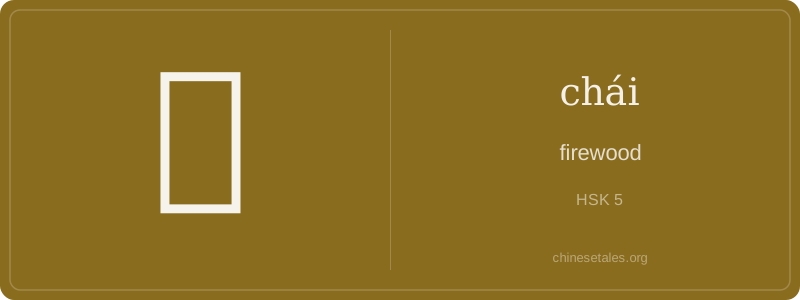
The earliest form of 柴 appears in bronze inscriptions as a vivid pictograph: two parallel vertical strokes (representing cut branches or logs) stacked above the 木 (tree/wood) radical — essentially, 'wood prepared for burning'. Over centuries, those simple lines evolved into the modern top component: 此 (cǐ), which looks like a stylized pair of bundled sticks crossing at an angle — imagine two logs lashed together, then simplified into 又 + 止-like shapes. The bottom 木 remained unchanged, anchoring the meaning in timber. By the seal script era, the structure solidified into today’s ten-stroke form: a clear visual echo of 'cut, dried, ready-to-burn wood'.
This practical origin shaped its semantic journey. In the *Shijing* (Book of Songs), 柴 appears in sacrificial contexts — firewood used to kindle altars for heaven and ancestors, linking it to ritual purity. Later, in Tang poetry, it softened into everyday symbolism: Du Fu wrote of '柴门闻犬吠' (barking dogs heard beyond the firewood gate), where 柴门 meant a humble gate made of rough planks — not just material, but social identity. Even today, the visual logic holds: the crossed strokes above 木 still whisper 'bound fuel', making 柴 one of Chinese writing’s most transparently iconic characters.
At its heart, 柴 (chái) is the humble, crackling essence of domestic warmth — firewood. But don’t mistake its simplicity for emptiness: this character carries the quiet weight of pre-modern survival. In ancient China, gathering 柴 wasn’t a chore — it was a daily ritual tied to family safety, cooking, and ancestral rites. The character feels grounded, earthy, and slightly rustic — never abstract or bureaucratic. You’ll rarely see it in formal policy documents, but you’ll hear it in village talk, folk songs, and idioms like 柴米油盐 (chái mǐ yóu yán), the four staples of household life.
Grammatically, 柴 is almost always a noun — uncountable by default, like 'wood' in English — so we say 一堆柴 (yī duī chái, 'a pile of firewood'), not *三根柴 (though colloquially, 一根柴 appears in fixed expressions). It rarely takes measure words unless specifying logs or bundles. Learners often mistakenly use it as a verb ('to chop wood') — but that’s 切 or 砍; 柴 itself never verbs. Also, while it literally means 'firewood', it’s sometimes used metaphorically for 'basic necessities' or even 'rough, unsophisticated people' (e.g., 柴夫 chái fū — a woodcutter, implying simplicity or rustic virtue).
Culturally, 柴 evokes nostalgia and authenticity — think of elderly grandparents stoking a brick stove, or the poetic line ‘野火烧不尽,春风吹又生’ (wildfire burns the grass, yet spring wind brings new life), where 柴 isn’t named but implied in the burning. A common learner trap? Confusing it with 采 (cǎi, 'to gather') — same sound in some dialects, but totally different meaning and radical. Remember: 柴 is *wood* for *burning*, not *harvesting*.