核
Character Story & Explanation
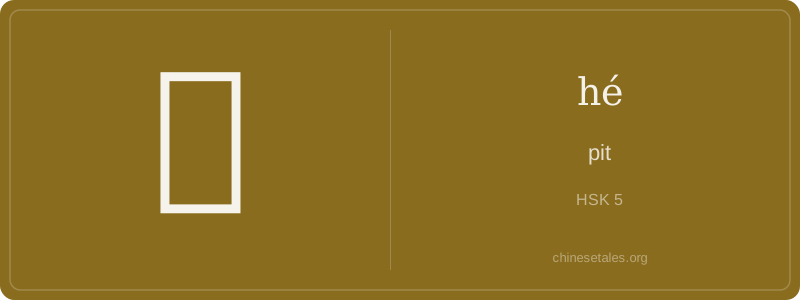
The earliest form of 核 appears in bronze inscriptions around 1000 BCE as a compound pictograph: a simplified 'tree' (木) on the left, and a stylized 'fruit with hard interior' on the right — often drawn as a round shape with a crossbar, representing the impenetrable stone inside a plum or peach. Over centuries, the right side evolved: the rounded fruit became the 'há' component (亥 + 早’s top), while the 'wood' radical (木) stayed firmly anchored on the left — visually anchoring the idea that pits belong to trees, not rocks or metal.
By the Han dynasty, 核 had already shifted from concrete fruit pit to abstract 'essential part' — Mencius used it metaphorically in the *Mengzi* (6A:7) when describing moral sprouts as the 'core' (核) of virtue. The character’s visual duality — wood-based yet signifying inner hardness — made it perfect for scientific borrowing: when Western concepts like 'nucleus' entered Chinese in the late 19th century, translators reached for 核 precisely because it evoked something small, dense, central, and generative — just like an atomic nucleus or a peach stone holding life within.
At its heart (pun intended), 核 feels like a quiet powerhouse — small in stroke count but massive in semantic range. It literally means 'pit' or 'stone' inside fruit (like peach pit), but in modern Chinese, it’s the go-to character for 'core', 'nucleus', and even 'nuclear'. This isn’t just linguistic expansion; it reflects how Chinese conceptualizes centrality: not as abstract authority, but as something tangible, enclosed, and vital — like the seed that holds the whole plant’s blueprint. You’ll hear it in daily speech ('core competence' 核心竞争力) and high-stakes contexts ('nuclear energy' 核能) with equal weight.
Grammatically, 核 rarely stands alone. It’s almost always part of compounds — either as a noun modifier (核燃料 'nuclear fuel') or in fixed phrases like 核对 (to verify, literally 'check the core'). Learners often mistakenly use it as a verb ('to nuclearize' — nope!), or confuse it with homophones like 合 (to join). Remember: 核 is a noun-root — it names *what* is central or contained, never *how* things connect.
Culturally, this character quietly embodies a deep-rooted reverence for essence over appearance. In classical medicine, the 'five zàng organs' were sometimes called 五核 — not because they’re hard like pits, but because they’re the irreducible functional cores of life. A common learner trap? Assuming 核 always implies danger ('nuclear bomb!'). But in food contexts (杏核 xìng hé — apricot pit) or education (核心课程 — core curriculum), it carries warmth, necessity, and quiet authority — like the unassuming stone that grows a tree.