档
Character Story & Explanation
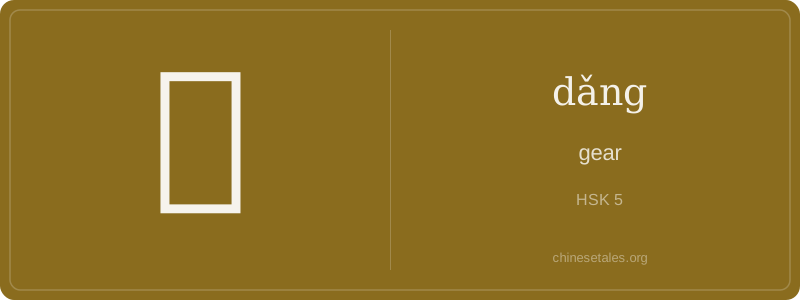
The earliest form of 档 appears in late Han clerical script, evolving from the character 檔 — a variant with 木 (wood) radical + 當 (dāng, 'to be equivalent'). Originally, 檔 referred to wooden tally sticks or matched bamboo slips used in ancient record-keeping: two identical pieces carved with matching notches, one kept by the state, one by the taxpayer — their 'correspondence' was the *dàng*. Over centuries, the left side simplified from 當 to 当, and the right retained 木, emphasizing the *material substrate* of official records — wood was the medium of archiving before paper.
By the Ming dynasty, 檔/檔 became standard for 'official documents stored in wooden cabinets', then broadened to any categorized set — grain reserves, military rosters, even musical pitch standards (音档). The gear meaning emerged only in the 20th century, borrowing the idea of 'discrete, calibrated positions' from mechanical engineering. Fascinatingly, the same visual logic applies: just as archival slips were slotted into wooden frames, gears are slotted into transmission shafts — both rely on precise alignment and functional hierarchy. Classical texts like the Ming Shi (History of Ming) use 檔 exclusively for registers; the mechanical sense first appears in 1930s automobile manuals translated from Japanese.
Imagine you’re test-driving a sleek new electric car in Shenzhen. The salesperson says, 'Try shifting into dǎng 2 — it gives more torque for city hills!' You nod, but inside you’re thinking: wait, isn’t 档 just about *files*? Yes — and gears! In modern Chinese, 档 (dǎng) is the go-to word for transmission gears (1档, 2档, etc.), but it’s also used for *file categories*, *quality tiers*, and even *institutional archives*. Its core feel is ‘a defined slot or level within a calibrated system’ — not just mechanical, but bureaucratic, digital, and social.
Grammatically, 档 almost always appears after a number or classifier: 一档 (yī dǎng), 高档 (gāo dàng), 档案 (dàng àn). Note the tone shift: it’s dǎng only when counting gears (1档, 2档); in all other contexts — files, quality levels, archives — it’s dàng. Learners often mispronounce 档案 as *dǎng àn*, which sounds like 'gear file' instead of 'archive'. Also, never use 档 alone — it’s always paired: you don’t say *这个档*, you say *这个档位* (gear position) or *高档货* (high-end goods).
Culturally, 档 reflects China’s love for systematic categorization — from civil service rankings to e-commerce product tags (‘中档价位’ = mid-tier pricing). A common mistake is overgeneralizing: 档 never means 'speed' or 'setting' by itself — that’s 模式 (módì) or 档位 (dàngwèi). And while it’s HSK 5, its real-world frequency spikes in tech manuals, real estate listings, and government forms — making it quietly indispensable.