权
Character Story & Explanation
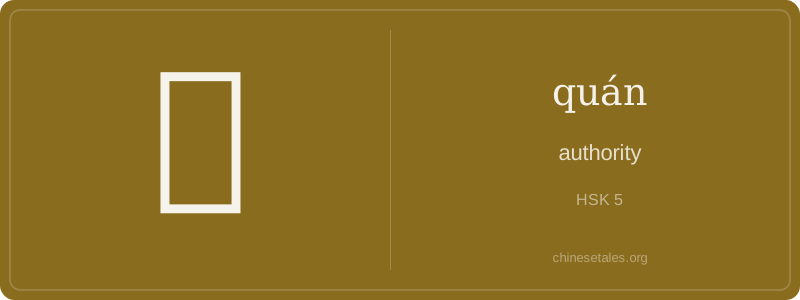
The earliest form of 权 appears in Warring States bamboo texts as ⿰木雚 — a tree (木) beside a phonetic component 雚 (guàn), which itself depicted a water bird with long legs and neck, later simplified to 又 + 王. The wood radical wasn’t arbitrary: ancient Chinese weights were made of standardized wooden rods or beams — literal ‘balance beams’. So 权 began as a pictophonetic character for a calibrated weighing tool, not abstract authority. Over centuries, the 雚 phonetic eroded into the modern 又 + 王 shape we see today — six clean strokes, yet carrying millennia of metrological precision.
This physical origin shaped its meaning profoundly: from ‘standard weight’ in the *Zuo Zhuan* (c. 4th c. BCE) — where rulers ‘set 权 to measure grain’ — to ‘the standard by which decisions are weighed’ in Han dynasty legal texts. By the Tang, 权 had fully abstracted into ‘authority’ and even ‘expedient strategy’ (权宜之计 quán yí zhī jì), reflecting the Daoist and Legalist idea that true authority lies not in rigidity, but in flexible, context-sensitive judgment — like adjusting weights for different loads.
At its core, 权 (quán) isn’t just ‘authority’ — it’s *measured* authority: the calibrated right to decide, weigh, or act. Think of a judge holding balanced scales, not a general barking orders. In Chinese, this character implies legitimacy, proportionality, and responsibility — authority that must be justified, delegated, or exercised within boundaries. That’s why you’ll see it in words like 发言权 (fā yán quán, ‘right to speak’) or 使用权 (shǐ yòng quán, ‘right of use’): it’s always tied to a specific domain and often shared or granted.
Grammatically, 权 is almost never used alone — it’s a noun that anchors compound words, rarely appearing without a modifier. Learners sometimes mistakenly try to say *‘I have quyền’* (using the Vietnamese spelling!) or treat it like an English verb (*‘to quan’*), but it’s strictly nominal and abstract. You don’t ‘quan’ something; you *hold*, *exercise*, *delegate*, or *infringe upon* 权. It also never takes aspect particles like 了 or 过 — it’s a conceptual noun, like ‘justice’ or ‘sovereignty’ in English.
Culturally, 权 reveals how deeply Chinese thought links power with balance and ritual precision — echoing ancient bronze weight standards and Confucian ideals of ‘rightful rule’ (正统 zhèngtǒng). A common learner trap? Over-translating 权 as ‘power’ (力量 lìliàng) — which connotes raw force — when 权 is about sanctioned, socially recognized prerogative. Misuse can subtly suggest illegitimacy: saying 滥用权力 (lànyòng quánlì) means ‘abusing authority’, not just ‘using power recklessly’.