欠
Character Story & Explanation
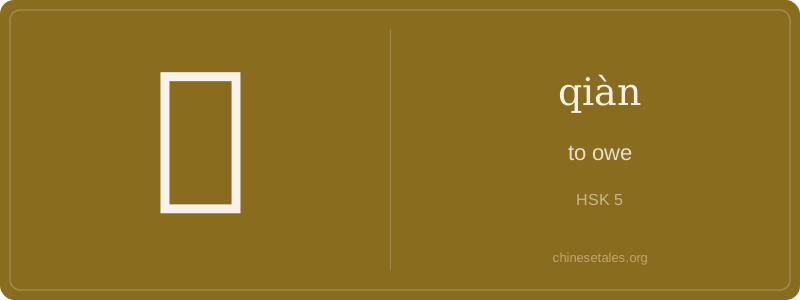
The earliest form of 欠 appears in oracle bone inscriptions as a stylized figure with an open mouth and tilted head—literally depicting a person yawning or sighing, breath visibly escaping upward. Over centuries, the ‘person’ simplified into the left-side component (the radical itself), while the right side evolved from a curved line suggesting exhaled air into today’s three-stroke ‘欠’ shape: the dot (a breath droplet?), the short slant (neck tilt), and the long downward stroke (exhale trail). By the seal script era, it was already unmistakably ‘someone breathing out’—not just yawning, but expressing longing, exhaustion, or unmet need.
This physical act of exhaling—of something leaving the body—became the semantic bridge to ‘lacking’ and then ‘owing’: what’s missing *from* you must be returned *to* someone else. The Shuōwén Jiězì (100 CE) defines it as ‘yawning due to deficiency’, linking bodily absence to social shortfall. By Tang dynasty poetry, 欠 was used metaphorically: Li Bai wrote ‘欠酒债’ (qiàn jiǔ zhài)—‘owed wine debts’—blending literal tavern tabs with poetic yearning. The visual echo remains: four strokes, all flowing downward… like breath, responsibility, or consequences slipping out of your control.
At its core, 欠 (qiàn) isn’t just about money—it’s about imbalance in relationships. In Chinese thinking, owing isn’t merely a financial transaction; it’s a social debt that unsettles harmony (hé). You can 欠 someone money, time, an apology, or even respect—and the character carries that weight of unfulfilled obligation, like a small but persistent knot in the fabric of guānxi (interpersonal ties).
Grammatically, 欠 is a transitive verb requiring a direct object: you *must* say what you owe—‘欠钱’ (qiàn qián), ‘欠人情’ (qiàn rénqíng), never just ‘我欠’ alone. Learners often mistakenly use it like English ‘I owe’ without specifying, or confuse it with passive constructions—but 欠 has no passive form and never takes ‘被’. Also, it doesn’t mean ‘to lack’ (that’s 缺 quē); saying ‘我欠水’ sounds like you personally borrowed water from someone—not that you’re dehydrated!
Culturally, the discomfort around 欠 reflects deep Confucian values: reciprocity is moral hygiene. Classical texts like the Book of Rites stress that failing to repay favors disrupts social order. Even today, avoiding 欠—especially 人情 (rénqíng, ‘human sentiment debt’)—is a quiet skill of emotional intelligence. And yes: forgetting to return a borrowed pen *does* register on the same moral frequency as skipping rent.