欣
Character Story & Explanation
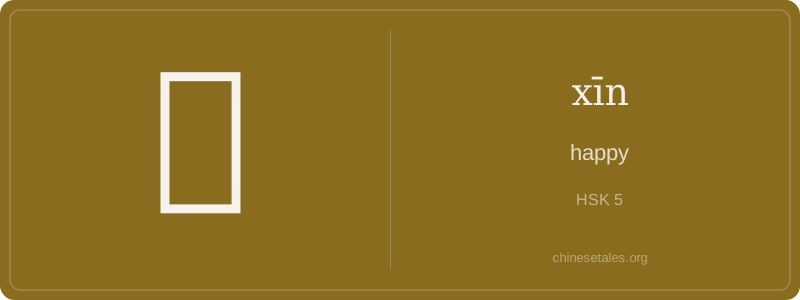
The earliest form of 欣 appears in Warring States bamboo slips—not as a pictograph, but as a phonosemantic compound already. Its left side, 欠 (qiàn), originally depicted a person opening their mouth to sigh or yawn (a recurring motif for breath-related actions), while the right side, 吝 (lìn, now obsolete as a standalone), served as the phonetic clue. Over centuries, 吝 simplified into 今 (jīn), losing its original meaning but preserving sound resemblance—so 欣 evolved from ‘breath + lìn’ to ‘breath + jīn’, visually streamlining to today’s eight-stroke form: three strokes for 欠 (⺈、一、欠), then five for 今 (ノ、丶、丨、、一).
This visual shift is deceptively clever: though 今 means ‘now’, it doesn’t contribute semantically—only phonetically. Yet the radical 欠 remains essential, anchoring 欣 to bodily expression—joy so vivid it escapes the mouth as a sigh, a laugh, or a gasp of delight. Classical texts like the Book of Rites use 欣 to describe the radiant joy of rulers seeing virtuous governance bear fruit; by the Tang dynasty, poets like Du Fu used 欣然 to convey serene, unforced acceptance. The character thus embodies joy that is both visceral and dignified—a feeling so genuine, it literally breathes.
Think of 欣 (xīn) as the Chinese equivalent of 'glee'—not just generic happiness, but a bright, outward-facing joy that bubbles up and shows on your face, like when you hear unexpected good news or witness someone else’s triumph. Unlike 快乐 (kuàilè), which is broad and neutral, or 高兴 (gāoxìng), which often implies situational cheer, 欣 carries a subtle layer of appreciation, admiration, or shared uplift—it’s the smile you wear when a friend wins an award, not just when you get ice cream.
Grammatically, 欣 rarely stands alone; it’s almost always in compounds (欣然, 欣赏, 欣喜) or as the first element in literary or formal expressions. You’ll never say *‘wǒ hěn xīn’ — that sounds unnatural and archaic. Instead, it shines in structures like 欣然接受 (xīn rán jiē shòu, 'accept gladly') or 欣赏 (xīn shǎng, 'to appreciate') — where it adds emotional resonance and refinement. Learners often mistakenly treat it like an adjective, but it functions more like a poetic intensifier fused with verbs or adverbs.
Culturally, 欣 reflects Confucian ideals of harmonious, socially attuned emotion: joy isn’t just personal—it’s relational and virtuous when expressed with grace. A classic mistake is overusing it in casual speech (e.g., texting ‘今天很欣!’); native speakers would raise an eyebrow — this character belongs in essays, speeches, or heartfelt letters, not WeChat memes. Its elegance comes with register awareness: it’s the tuxedo of happiness characters — impressive, but wildly inappropriate at a barbecue.