武
Character Story & Explanation
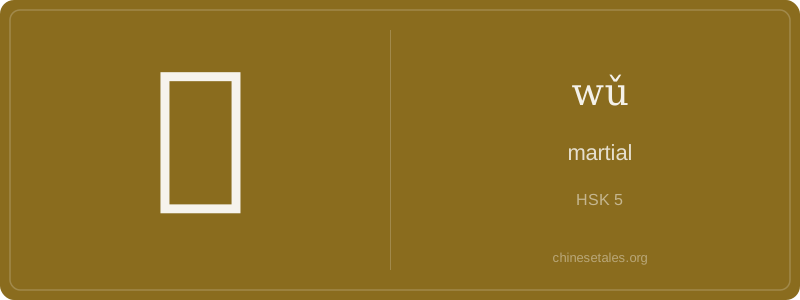
The earliest form of 武 appears on Shang dynasty oracle bones as ⿱戈止 — a spear (戈) above a foot (止), literally ‘to advance with weapon’. The foot radical 止 wasn’t passive; it depicted a foot planted firmly mid-stride — not stopping, but *moving forward purposefully in defense*. Over centuries, the top evolved: the spear’s blade simplified into the ‘w’-shaped 戈 component (now written as 戊 in seal script), while the foot remained unmistakably 止. By Han dynasty clerical script, strokes standardized into today’s eight: the top-left 戊 (5 strokes) plus bottom 止 (3 strokes), totaling 8 — a number symbolizing balance and completeness in ancient cosmology.
This visual logic shaped its meaning profoundly: 武 was never ‘violence’ — it meant ‘the act of advancing with righteous force to stop chaos’. Confucius praised ‘wen wu bìng yòng’ (civil and martial used together) in the *Analects*, and Sun Tzu wrote that ‘the supreme art of war is to subdue the enemy without fighting’ — echoing 武’s original ethos. Even the character’s structure enacts this: the foot (止) below suggests grounding and control, while the weapon (戊) above shows intention — not rage, but resolve. In Tang poetry, 武 often appears paired with 文 (wen), as in ‘wen wu quan cai’ (‘fully accomplished in civil and martial arts’), celebrating the ideal scholar-general.
At its core, 武 isn’t just ‘martial’ in the Hollywood sense of punching and kicking — it’s a deeply philosophical concept rooted in restraint, legitimacy, and moral force. In classical Chinese thought, true ‘wu’ (martial virtue) is inseparable from ‘wen’ (civil/cultural virtue); they’re two halves of statecraft, like yin and yang. You’ll rarely see 武 alone in modern speech — it almost always appears in compounds (e.g., 武器, 武术, 武装), never as a standalone adjective like ‘martial’ in English. Saying *‘tā hěn wǔ’* (‘he is very martial’) sounds unnatural — native speakers would say *‘tā hěn yǒu wǔqì’* (‘he’s very weapon-possessing’ → figuratively, ‘imposing’) or use context-rich phrases like *‘wǔdé gāo shàng’* (‘high martial virtue’).
Grammatically, 武 functions exclusively as a noun or noun modifier — never a verb or predicate adjective. It also carries subtle register weight: using 武 in formal writing (e.g., 武装冲突, ‘armed conflict’) signals gravity and institutional authority, while in colloquial contexts, it often evokes tradition or discipline (e.g., 武术馆, ‘martial arts school’). Learners frequently overgeneralize it — mistaking it for ‘military’ (军队) or ‘warlike’ (好战), when in fact 武 implies justified, disciplined, even ceremonial force. A general who wages reckless war loses 武dé (martial virtue); a monk who masters self-control embodies it.
Culturally, 武 reveals how Chinese civilization historicizes power: strength without virtue is ‘bùwǔ’ (not-wu) — not just ineffective, but illegitimate. This is why ‘Wu Lin’ (Martial Forest, i.e., Wushu) isn’t about domination — it’s about harmony between body, breath, and ethics. Mispronouncing it as ‘wú’ (second tone) — a common slip — won’t break comprehension, but it subtly distances you from classical resonance, where wǔ (third tone) carries the weight of measured, decisive action.