歪
Character Story & Explanation
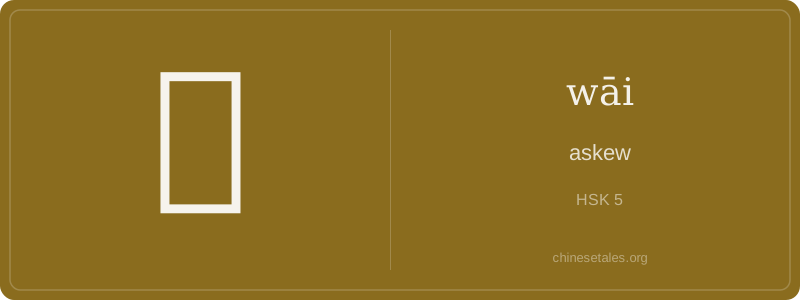
The earliest form of 歪 appears in seal script as two components stacked: 上 (shàng, ‘above’) over 止 (zhǐ, ‘to stop’, the radical). But look closer — it’s not just ‘stop above’. Oracle bone inscriptions suggest a pictographic origin: a stylized human figure standing *off-balance*, with one foot planted and the other lifted or shifted sideways — the top part evoking a tilted head or torso, the 止 radical anchoring the unstable stance. Over centuries, the upper component simplified from a head-and-arms glyph into the modern 又 (yòu, ‘again’) shape — not because of meaning, but due to phonetic borrowing and stroke economy. By Han dynasty clerical script, 歪 had settled into its current 9-stroke structure: 又 (3 strokes) + 止 (6 strokes), visually echoing asymmetry through uneven stroke weight and direction.
This visual instability directly birthed its semantic core: ‘not upright’. In classical texts like the Shuōwén Jiězì (121 CE), 歪 is glossed as ‘不正也’ (bù zhèng yě, ‘not upright’), emphasizing moral and physical deviation. Its usage expanded from literal posture (《庄子》describing a crooked tree) to metaphorical distortion — yet always retaining that sense of *intentional or accidental deviation from center*. Unlike characters for ‘broken’ or ‘bent’, 歪 preserves agency and motion: a 歪笑 is a knowing, lopsided smile; a 歪门 is a crooked door — still functional, just delightfully askew.
Imagine you’re at a Beijing hutong teahouse, watching an elderly master balance a porcelain cup on his nose — then suddenly sneeze! The cup tilts wildly, wobbling left-right, refusing to sit straight. That’s 歪 (wāi) in action: not just ‘crooked’ like a bent wire, but dynamically *off-kilter*, unbalanced, defiantly asymmetrical — with a hint of charm or mild chaos. It’s the slant of a tilted hat, the lopsided grin of a mischievous child, the leaning of a street sign after a typhoon.
Grammatically, 歪 is mostly an adjective (‘askew’, ‘crooked’) or verb (‘to tilt’, ‘to skew’), often used in vivid descriptive phrases — never as a standalone noun like ‘a歪’. You’ll hear it in constructions like 歪着头 (wāi zhe tóu, ‘tilting one’s head’), 歪打正着 (wāi dǎ zhèng zháo, ‘hitting the target by accident’ — literally ‘askew-hit-correct-hit’), or as a reduplicative 歪歪 (wāi wāi, ‘crookedly’). Learners mistakenly use it for permanent deformity (that’s 歪曲 wāiqū, ‘distort’) or confuse it with static ‘bent’ (弯 wān); 歪 implies *active imbalance*, not structural damage.
Culturally, 歪 carries playful irreverence — think of the slang phrase 歪理 (wāi lǐ, ‘crooked logic’), meaning clever but logically flawed reasoning, often used affectionately. And yes, that rare alternate pronunciation wǎi appears only in regional dialects (like Shandong) or fixed idioms like 歪歪扭扭 (wǎi wǎi niǔ niǔ, ‘wobbly, shaky’), where tone sandhi softens the first syllable — but for HSK 5, stick firmly with wāi.