殊
Character Story & Explanation
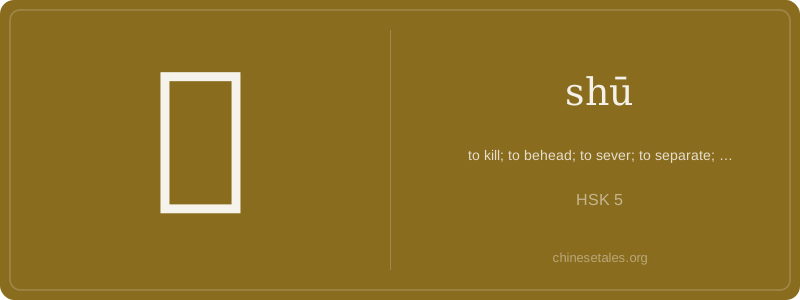
The earliest form of 殊 appears on late Shang oracle bones as a combination of 歹 (a stylized skeleton or corpse) and 朱 (zhū, originally a pictograph of a tree with red dye — later simplified to a dot + cross). But here’s the twist: 朱 wasn’t just color — in bronze inscriptions, it doubled as a phonetic component *and* subtly evoked ‘redness’ (blood) and ‘clarity’ (red dye marked official documents). Over centuries, the 朱 evolved into the modern upper-right shape (一 + 丶 + 丨), while 歹 retained its grim, angular form — a visual contract between violence and precision.
This duality shaped its meaning: from concrete ‘beheading’ (as in the Warring States text *Zuo Zhuan*: ‘斩首曰殊’) to abstract ‘radical distinction’. By the Han dynasty, scholars like Xu Shen noted in the *Shuōwén Jiězì* that 殊 meant ‘to sever and thus make unique’ — a philosophical leap where physical separation birthed conceptual singularity. Its use in Buddhist sutras for ‘transcendent insight’ (e.g., 殊胜 shūshèng, ‘supreme excellence’) shows how deeply its original violence was sublimated into spiritual elevation.
At its heart, 殊 is a character steeped in visceral finality — it began as a pictograph of decapitation, and even today, its radical 歹 (dǎi, 'death' or 'dying') whispers danger. Don’t let its modern polite uses like ‘special’ or ‘exceptional’ fool you: this character carries the weight of ancient battlefield justice. Its core semantic field orbits *irreversible separation* — whether severing a head, parting ways forever, or rising so far above others that no comparison remains possible.
Grammatically, 殊 rarely stands alone in speech; it’s almost always bound in compounds or used adverbially in classical or literary contexts. You’ll hear 殊为 (shū wéi) meaning ‘especially, exceedingly’ — not ‘to kill’! Learners often misread shū as ‘shú’ (like 熟) or overgeneralize its ‘special’ sense, missing how it implies *radical difference*, not just pleasant uniqueness. In formal writing, 殊 can intensify verbs: 殊死 (shū sǐ, ‘desperate, life-or-death’) isn’t ‘killing death’ — it’s ‘fighting with severed ties to survival’.
Culturally, 殊 appears in solemn, high-register phrases — think imperial edicts or funeral eulogies — where its gravity still resonates. A classic mistake? Using 殊 when you mean 特别 (tèbié) in casual speech — it sounds archaic or even ominous. Remember: 殊 doesn’t mean ‘cool’ or ‘fun’ — it means ‘uniquely consequential’, sometimes literally life-ending.