睡
Character Story & Explanation
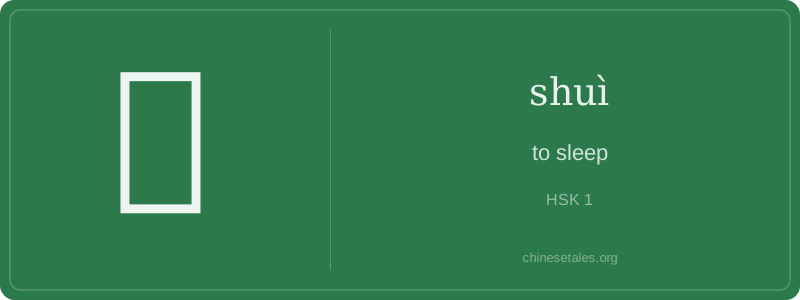
The earliest form of 睡 appears in Warring States bamboo slips — not as a pictograph of a person lying down, but as a vivid fusion: the left side 目 (mù, ‘eye’) + the right side 垂 (chuí, ‘to hang down’). Imagine ancient scribes observing someone’s eyelids literally *drooping*, heavy and slack — the character captures that precise visual moment: eyes sagging downward like weighted silk. Over centuries, 垂 simplified into the modern 睡’s right-hand component (垂 → → eventually the current shape), while 目 remained firmly anchored on the left, grounding the meaning in vision — or rather, its surrender.
This origin explains why 睡 feels so bodily and sensory: it’s not abstract ‘rest’, but the physical collapse of vigilance. In the Shuōwén Jiězì (100 CE), Xu Shen defined it as ‘eyes closed, body at ease’ — linking physiology to tranquility. By the Tang dynasty, poets like Li Bai used 睡 metaphorically: ‘醉后不知天在水,满船清梦压星河’ (After wine, unaware heaven floats on water — my dream presses down on the starry river), where 睡’s quiet weight evokes deep, immersive unconsciousness. The character’s very structure — eyes yielding — remains an elegant, millennia-old snapshot of human vulnerability.
At its heart, 睡 (shuì) isn’t just ‘to sleep’ — it’s the quiet surrender to rest that Chinese culture treats as both physiological necessity and subtle social act. Unlike English, where ‘sleep’ is neutral, 睡 often implies intentional, conscious cessation of activity: you *decide* to 睡, not just drift off. That’s why you’ll rarely hear ‘I’m sleepy’ expressed with 睡 — instead, learners say 我困了 (wǒ kùn le) for ‘I’m tired’. Using 睡 directly for ‘I’m sleepy’ sounds oddly deliberate, like announcing, ‘I hereby initiate slumber!’
Grammatically, 睡 is a simple intransitive verb — no object needed — but it’s highly sensitive to aspect markers. You say 他睡了 (tā shuì le) for ‘He fell asleep’ (completed action), but never *他睡着了* without context — because 着 (zhe) here signals ongoing state, so 睡着了 (shuì zháo le) actually means ‘has fallen asleep and is now asleep’, a nuance English lacks. Beginners often overuse 睡 in place of 睡觉 (shuì jiào), the more natural, colloquial compound — think of 睡 as the ‘formal verb’ and 睡觉 as the ‘everyday phrase’.
Culturally, 睡 carries unspoken etiquette: saying 我要睡了 (wǒ yào shuì le) to end a phone call signals polite finality — not rudeness, but respect for boundaries and circadian rhythm. Interestingly, in classical texts, 睡 was sometimes used euphemistically for death (e.g., in Buddhist sutras), reflecting how deeply rest and release are intertwined in Chinese thought — a gentle reminder that even verbs hold philosophy.