租
Character Story & Explanation
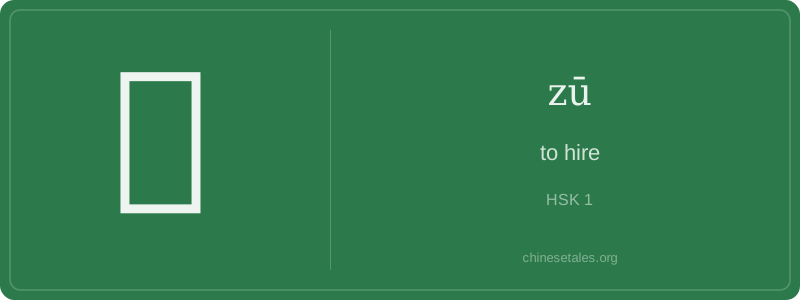
The earliest form of 租 appears in bronze inscriptions around 1000 BCE — not as a pictograph of farming, but as a compound: 禾 (grain) + 且 (a phonetic component, later simplified to 冗 in modern writing). Wait — why grain? Because in ancient Zhou dynasty tax systems, ‘rent’ was literally paid in harvested crops! The top part 禾 vividly depicts stalks of rice or millet swaying in the wind; the bottom originally looked like 且 (a ritual tablet), hinting at formal, sanctioned exchange. Over centuries, 且 morphed into the streamlined 冗-like shape we see today — four strokes forming a compact, grounded base beneath the禾.
This character’s evolution mirrors China’s economic history: from feudal grain tributes (‘paying rent to the lord with your harvest’) to Tang dynasty urban lease contracts, to today’s QR-code scooter rentals. In the classic text *The Book of Rites*, 租 appears in discussions of ‘just taxation’ — linking fairness to land use. Visually, the 禾 radical roots 租 in sustenance and obligation: to rent is not just to use, but to give back — a silent contract written in stalks of grain and ink.
At its core, 租 (zū) feels transactional and practical — it’s the word you use when something valuable changes hands temporarily, usually for money. Unlike English ‘rent’ which leans toward real estate, 租 in Chinese covers everything from scooters to wedding dresses to office space. It carries no emotional weight — it’s neutral, efficient, and slightly bureaucratic. You’ll hear it on street signs (‘租电动车’), in apps (‘滴滴租车’), and even in casual speech: ‘能租我橡皮吗?’ (Can I borrow your eraser?) — yes, even borrowing small items can be 租 in playful or emphatic contexts!
Grammatically, 租 is a verb that takes the structure [Subject] + 租 + [Object] + (给 + Recipient). It pairs naturally with aspect particles: 我租了三周 (I rented it for three weeks) or 他正在租房子 (He’s renting an apartment right now). Crucially, 租 is transitive — it always needs a direct object (you rent *something*), unlike English where ‘I’m renting’ alone is fine. Learners often omit the object and sound vague or incomplete.
Culturally, 租 reflects China’s rapid urbanization and sharing economy boom — ‘renting’ isn’t second-best here; it’s smart, flexible, and status-neutral. A common mistake? Confusing 租 with 借 (jiè, to borrow/lend without payment). Using 租 when you mean ‘borrow a book from a friend’ implies you’re paying — awkward! Also, note: 租 doesn’t imply ownership transfer (like 买), just temporary access. That subtle boundary between access and possession? That’s the quiet philosophy inside this little 10-stroke character.