洒
Character Story & Explanation
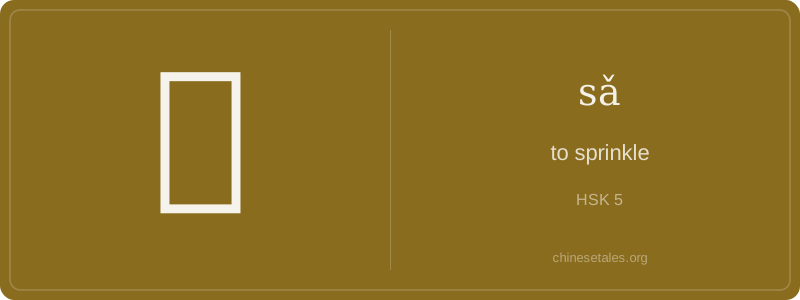
The earliest form of 洒 appears in Warring States bamboo texts as a combination of 水 (water) and 西 (xī, originally a pictograph of a bird’s nest or basket — later phonetic). In seal script, it evolved into 氵+西: three water dots on the left, signaling liquid action, and 西 on the right serving both sound (xī → sǎ via tone shift and dialectal change) and subtle meaning — 'west' was associated with decline and dispersal in ancient cosmology, reinforcing the idea of things spreading outward. The nine strokes solidified in clerical script: the three dots flow down, then 西 is written with its distinctive square frame and inner cross-strokes — like a container releasing contents.
By the Han dynasty, 洒 had moved beyond literal sprinkling to metaphors of emotional release: Sima Qian used 洒泪 in the *Records of the Grand Historian* to describe loyal ministers weeping openly yet respectfully. Tang poets like Li Bai employed 洒然 ('scattered-so') to evoke sudden, effortless clarity — as if mental fog had been sprinkled away. Even today, the visual rhythm of 洒 — water flowing *outward* from a bounded shape (西) — mirrors its semantic core: containment transformed into gentle, purposeful dispersion.
Imagine a summer afternoon in Beijing: an old man in a blue cotton shirt stands by his courtyard fountain, lifting a brass ladle and flicking water upward — not to drench, but to scatter fine droplets that catch the light like liquid glitter. That delicate, intentional, airborne dispersal? That’s 洒 (sǎ). It’s not dumping or pouring; it’s *controlled release* — think sprinkling tea leaves into a pot, dusting flour over dough, or even shedding tears quietly. The character evokes grace, precision, and lightness: you 洒水 (sprinkle water), 洒泪 (shed tears), or 洒脱 (be carefree — literally 'scatter detachment').
Grammatically, 洒 is almost always transitive and pairs with objects indicating what’s being dispersed: 洒盐 (sprinkle salt), 洒香水 (spritz perfume). It rarely stands alone — you won’t say 'I sǎ' without specifying *what* you’re scattering. Learners often mistakenly use it for heavy actions like 'pour' (倒 dào) or 'spill' (洒 can mean 'spill' only in fixed idioms like 洒落, never as a standalone verb for accidental loss).
Culturally, 洒 carries poetic weight: in classical poetry, 洒泪 means weeping with dignity; 洒血 ('scatter blood') implies heroic sacrifice, not gore. A common trap? Confusing it with 晒 (shài, 'to sun-dry'), which looks similar but has 日 (sun) instead of 氵 (water). Remember: if there’s water involved — literal or metaphorical — and it’s flying *in tiny bits*, it’s probably 洒.