滩
Character Story & Explanation
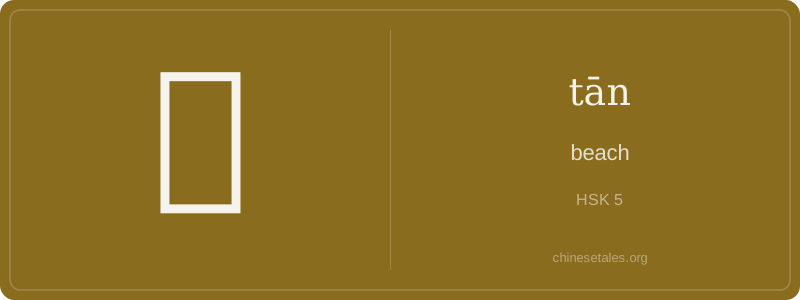
The earliest form of 滩 appears in Han dynasty clerical script, evolving from a bronze inscription that fused 水 (water) on the left with a simplified form of 叚 — originally depicting a person wearing a mask (in oracle bone script), later repurposed for sound. In seal script, the left side solidified into the three-dot water radical 氵, while the right side stabilized as 叚 (jiǎ), losing its mask meaning but keeping its pronunciation. Stroke-by-stroke: start with the three water dots (氵), then write the top horizontal stroke of 叚, followed by the ‘square’ frame (冂), then the inner ‘cross’ (十), and finish with the final horizontal stroke — 13 strokes total, mirroring the rhythmic ebb and flow it describes.
By the Tang dynasty, 滩 had shifted from a technical term for ‘exposed riverbed’ (as in Du Fu’s poems describing Yangtze floodplains) to a broader poetic signifier of transitional space — where journeys begin, goods are unloaded, and stories wash ashore. In classical texts like the *Water Margin*, ‘上滩’ (shàng tān) meant ‘to haul a boat onto the shallows,’ a physically grueling act that became shorthand for overcoming obstacles. Visually, the water radical dripping down the left and the stable-yet-open 叚 on the right perfectly mirror the character’s essence: liquid force meeting temporary ground.
At its heart, 滩 (tān) is all about the liminal — that shimmering, shifting boundary where water surrenders to land. It’s not just any stretch of shore: it evokes wet sand, pebbles glistening after a receding wave, or silt banks exposed at low tide. Unlike 海滩 (hǎi tān), which specifies 'seaside beach,' 滩 alone carries a quieter, more geological weight — think riverbanks, tidal flats, or even barren desert ‘beaches’ in poetic usage (e.g., 沙滩 vs. 沙漠滩 — though the latter is rare and literary). The radical 氵 (three dots of water) anchors it firmly in the aquatic realm, while the 叚 (jiǎ) component, though now phonetic, once hinted at ‘false’ or ‘temporary’ — subtly echoing how beaches are constantly remade by water.
Grammatically, 滩 behaves like a concrete noun but often appears in compound nouns rather than standalone. You’ll rarely hear ‘这个滩很美’ in casual speech — instead, it’s 沙滩 (shā tān, sandy beach), 河滩 (hé tān, riverside shoal), or in set phrases like 滩头 (tān tóu, ‘beachhead’ — used metaphorically for the front line of any effort). Learners sometimes overextend it to mean ‘coast’ (coast = 海岸 hǎi àn) or confuse it with plain ‘land’ — but 滩 always implies moisture, sediment, and transience. A beach isn’t static real estate; it’s nature negotiating in real time.
Culturally, 滩 appears in idiom and song: 滩头浪 (tān tóu làng, ‘waves at the beachhead’) symbolizes imminent change or challenge, and folk songs from the Yellow River basin speak of ‘黄河滩’ (Huáng Hé tān) — not as vacation spots, but as sites of labor, flood risk, and stubborn resilience. Mistake alert: Don’t swap 滩 for 坛 (tán, ‘altar’) — same sound, totally different world: one holds water and gravel, the other holds incense and ancestors.