炒
Character Story & Explanation
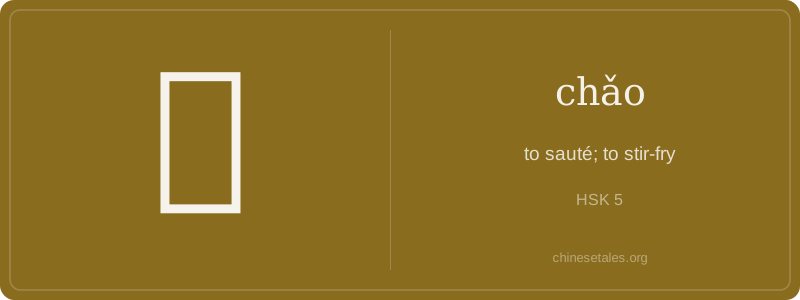
The earliest form of 炒 appears in Han dynasty clerical script as a combination of 火 (fire) on the left and 少 (a simplified variant of 沙, ‘sand’) on the right — not ‘few’, but a phonetic component hinting at pronunciation. Over centuries, the right side evolved: bronze inscriptions showed fire + a hand holding a spatula-like tool; by Tang dynasty, the ‘spatula’ stylized into 少, while the fire radical remained fiercely literal — eight strokes mirroring the flicker and crackle of real flame. The top dot? A spark. The four strokes beneath? Flames licking upward. Even today, those eight strokes feel like heat radiating from the page.
Originally, 炒 meant ‘to dry-roast grains over fire’ — mentioned in the 3rd-century text *Qimin Yaoshu*, describing how farmers toasted soybeans to preserve them. By the Song dynasty, it had shifted to describe quick-cooking in oil, reflecting urbanization and the rise of wok-based street food. The character’s visual duality — fire plus motion — perfectly mirrors its semantic journey: from preserving grain to energizing meals. In classical poetry, 炒 rarely appears, but its absence speaks volumes: it was too humble, too domestic — the kind of word written on market stalls, not palace scrolls.
Imagine Chef Lin in her Beijing kitchen — wok blazing, oil shimmering, garlic sizzling like tiny fireworks. She tosses broccoli, beef strips, and a splash of soy sauce into the heat, then *chǎo* — that rapid, rhythmic tossing-and-stirring motion that defines Chinese home cooking. That’s 炒: not just ‘fry’, but a dynamic, high-heat, *active* cooking method where ingredients dance in the wok. It’s the heartbeat of everyday Chinese cuisine — you don’t just ‘cook’ stir-fry; you *chǎo* it.
Grammatically, 炒 is almost always a transitive verb requiring a direct object: you *chǎo* vegetables, *chǎo* rice, *chǎo* eggs. You can’t say ‘I’m chǎo-ing’ alone — it demands what’s being tossed. It also appears in vivid compounds: *chǎo cài* (stir-fried dish), *chǎo fàn* (fried rice), and even metaphorically — *chǎo gǔpiào* (‘to stir-fry stocks’, i.e., trade speculatively). Learners often mistakenly use it for baking or boiling — but 炒 implies fire, motion, and immediacy. No steam, no oven, no simmer: just flame, flip, and flavor.
Culturally, 炒 embodies efficiency and control — one wok, one heat source, under three minutes. Mispronouncing it as chāo or cháo changes nothing (it’s firmly chǎo), but confusing it with similar-looking characters like 少 or 抄 derails your meaning entirely. And yes — when your friend says she ‘chǎo le yīgè píngguǒ’ (stir-fried an apple), she’s joking… unless she’s experimenting with avant-garde Cantonese dessert.