炭
Character Story & Explanation
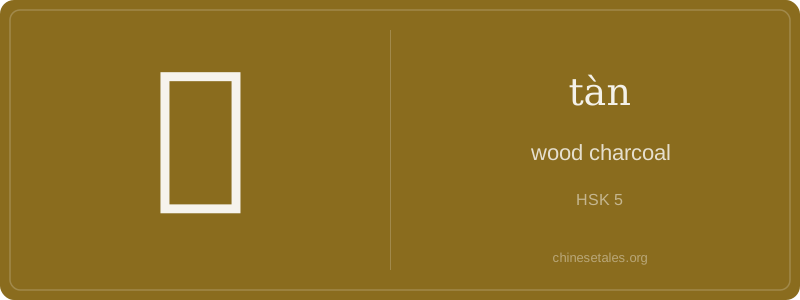
The earliest form of 炭 appears in bronze inscriptions as a stylized ‘wood’ (木) stacked over ‘fire’ (灬, a variant of 火), showing logs burning down to embers. By the seal script era, the top evolved into 山 (shān) — not ‘mountain’, but a simplified depiction of layered, smoldering wood piles — while the bottom solidified into 火 (huǒ), the fire radical. The modern 9-stroke form crystallized in clerical script: 山 (3 strokes) above 火 (4 strokes), plus two subtle connecting strokes — totaling nine, echoing the careful, time-bound process of charcoal-making.
This visual logic mirrors its semantic journey: from ‘wood undergoing controlled fire’ to ‘the purified residue left behind’. In the Shuōwén Jiězì (121 CE), Xu Shen defined it as ‘burnt wood’ (燒木餘也), emphasizing what remains *after* combustion — not the flame, not the smoke, but the dense, energy-rich core. By the Tang dynasty, 炭 was already embedded in daily life: Bai Juyi’s famous poem ‘Buying Charcoal’ (《賣炭翁》) opens with ‘Old Man Selling Charcoal’ — his cart groaning under ‘a thousand pounds of charcoal’ (千餘斤炭), highlighting its value as portable, storable heat. The character’s shape — mountain-like layers atop fire — silently tells the story of containment, patience, and transformation.
Imagine you’re in a Beijing hutong on a frosty winter evening: an old man crouches beside a brazier, carefully arranging glowing black lumps with metal tongs — not coal, not briquettes, but dense, hand-carbonized hardwood charcoal. That’s 炭 (tàn): not just ‘charcoal’ as a generic fuel, but specifically *wood* charcoal — the kind that burns clean, hot, and smokeless, prized for roasting chestnuts, heating traditional stoves, or even crafting ink. It carries a quiet, earthy weight — never used for industrial coal (that’s 煤, méi), and never for ash (灰, huī). You’ll see it in compound nouns, rarely alone.
Grammatically, 炭 almost never stands solo in speech; it’s a classic ‘bound morpheme’. You won’t say ‘I bought炭’ — you’ll say 木炭 (mù tàn, ‘wood charcoal’) or 竹炭 (zhú tàn, ‘bamboo charcoal’). It can function as a noun modifier (炭火, tàn huǒ — ‘charcoal fire’) or appear in measure word constructions like 一炉炭 (yī lú tàn — ‘one brazier-load of charcoal’). Learners often mistakenly use it where English says ‘coal’ — but in Chinese, coal mining is 煤矿 (méi kuàng), never 炭矿. Confusing the two risks sounding like you’re digging up barbecue briquettes!
Culturally, 炭 evokes craftsmanship and quiet endurance: traditional charcoal makers (炭工, tàn gōng) spend days sealing wood in earthen kilns, transforming timber into near-pure carbon — a metaphor for refinement and resilience. In classical poetry, 炭 appears in contrast to fire’s transience (e.g., ‘炭尽炉寒’, tàn jìn lú hán — ‘charcoal exhausted, stove cold’), underscoring impermanence. Modern usage leans practical — think eco-friendly bamboo charcoal deodorizers or high-end Japanese binchōtan grilling — but the character still whispers of slow, elemental transformation.