煤
Character Story & Explanation
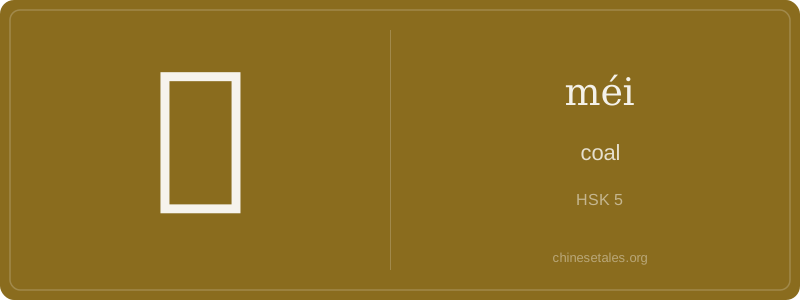
The earliest form of 煤 appears in Han dynasty seal script, not oracle bones (coal wasn’t widely mined until later), but its structure tells an ancient tale: left side 火 (fire) + right side 媒 (méi, ‘matchmaker’). Wait — why a matchmaker? Because in classical Chinese, 媒 carried the phonetic function (sound clue), not meaning — it was borrowed purely for its pronunciation, while 火 signaled the semantic domain: anything combustible. Over centuries, the right side simplified from 媒’s full 12 strokes to today’s 7-stroke 媒-like shape — losing the ‘female’ radical (女) but keeping the ‘soil’ (土) and ‘mouth’ (口) hints of grounded, earthy substance.
This ‘fire + sound-of-mei’ design reflects how early Chinese lexicographers categorized resources: by origin (earth-mined) and behavior (burns). By the Tang dynasty, 煤 appeared in poetry describing northern winters — Du Fu wrote of ‘coal smoke curling over city walls’ — confirming its shift from rare fuel to urban necessity. The character’s visual duality — fire on the left, earth-bound phonetic on the right — perfectly mirrors coal’s essence: subterranean matter that unleashes flame. No wonder it became the go-to term when China began mapping its vast coal reserves in the Ming era: it wasn’t just ‘black rock’ — it was *fire’s hidden bride*, waiting to be lit.
Think of 煤 (méi) as Chinese ‘coal’ — but not the dusty lump you toss into a fireplace. In Chinese, it’s a *material noun with built-in industrial gravity*: it rarely stands alone; instead, it anchors compound words like ‘coal mine’ or ‘coal-fired power plant,’ much like how ‘steel’ in English rarely appears without ‘mill,’ ‘industry,’ or ‘toe.’ You won’t hear someone say ‘I burned some coal’ — they’ll say ‘I burned coal briquettes’ (烧煤球) or ‘the power plant uses coal’ (电厂用煤). Its tone (méi, second tone) even sounds like the English word ‘may’ — as in ‘may I use coal?’ — a tiny auditory nudge toward its functional, permission-adjacent role in energy discourse.
Grammatically, 煤 is uncountable and never takes measure words like 个 or 张 — unlike ‘a piece of coal’ in English, you’d say 一块煤 (yī kuài méi), where 块 is the *only* standard classifier for solid lumps of mineral matter. Learners often mistakenly use 个, triggering a subtle ‘off’ feeling for native speakers — like saying ‘a coal’ in English. Also, 煤 is almost never used metaphorically: no ‘coal-black hair’ (that’s 炭 or 墨); it stays stubbornly literal, tied to geology and industry.
Culturally, 煤 carries the soot-and-sweat weight of China’s 20th-century industrialization — think Shanxi province’s mining towns or Mao-era slogans about ‘self-reliance through coal and iron.’ Yet today, it’s also a quiet symbol of transition: government reports now pair 煤 with terms like ‘clean utilization’ (清洁利用) and ‘peak coal’ (煤达峰), revealing how this ancient character is now at the heart of climate policy debates — a fossil fuel being gently, urgently, rewritten into history.