煮
Character Story & Explanation
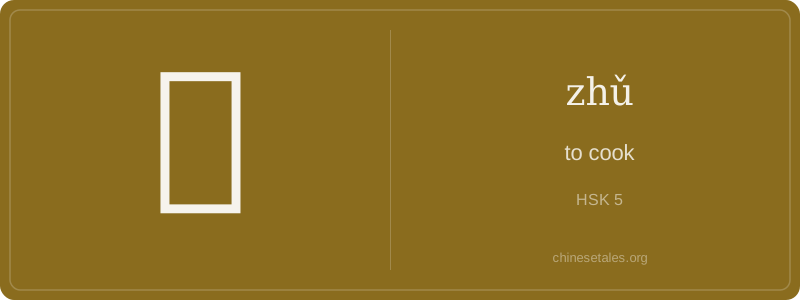
The earliest form of 煮 appears in bronze inscriptions as a combination of 爪 (claw/hand, later evolving into 炙) above a pot-like vessel (缶), with fire (灬) underneath — literally ‘hand stirring a pot over fire.’ Over centuries, the upper component simplified: 爪 merged with 者 (a phonetic hint for zhǔ), while the lower fire radical stabilized as 灬 (four dots), representing flames licking the base of the cauldron. By the Han dynasty, the structure was fixed: 者 + 灬 — 12 strokes total, each dot of the fire radical deliberately placed to evoke steady, even heat.
This visual logic mirrors its semantic journey: from early ritual boiling of sacrificial offerings (recorded in the *Book of Rites*) to everyday domestic practice. In classical texts like the *Mencius*, 煮 appears in metaphors of moral refinement — ‘the heart is like grain being 煮 into nourishing porridge.’ Even today, the shape whispers its truth: no fire without vessel, no transformation without containment. The four dots aren’t random — they’re the gentle, persistent bubbles rising in a simmering pot, a reminder that true change requires both heat and receptivity.
Imagine you’re in a bustling Chengdu teahouse at dawn: steam rises from a black iron wok over a roaring charcoal fire, and an elderly chef stirs a bubbling pot of spicy mapo tofu — not just heating it, but actively transforming raw ingredients through sustained heat and attention. That’s 煮 (zhǔ): it’s not generic ‘cooking’ like 做饭, but the precise, intentional act of *boiling*, *simmering*, or *stewing* — always involving liquid, time, and controlled fire. It carries a quiet intensity: you 煮 tea, 煮中药, 煮粥 — never 煮 steak (that’s 煎 or 烤). The character implies patience and process, not speed.
Grammatically, 煮 is a transitive verb that usually takes a direct object (煮面, 煮咖啡), and frequently appears in resultative or aspectual constructions: 煮熟 (cook until done), 正在煮 (is cooking right now), or 煮烂 (simmer until tender). Learners often mistakenly use it for dry-heat methods — a classic slip that turns ‘I’m grilling lamb’ into ‘I’m boiling lamb.’ Also, note: it rarely stands alone as a command (‘Cook!’); instead, say 快把汤煮上!(Get that soup boiling!)
Culturally, 煮 reflects China’s deep reverence for slow transformation — think of herbal decoctions (煎药) where herbs must be 煮 for hours to extract efficacy, or the Confucian metaphor of self-cultivation as ‘being slowly cooked by virtue.’ And yes — despite its radical 灬 (fire), 煮 is never used for fire itself; that’s 火 or 焚. The fire is always *in service of the liquid* — a subtle but vital distinction.