狂
Character Story & Explanation
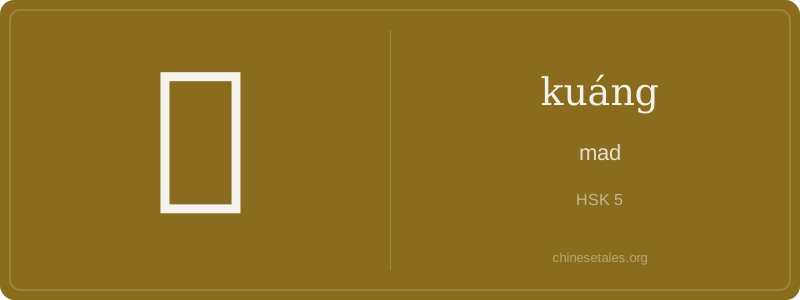
Trace back to oracle bone script (c. 1200 BCE), and 狂 began as a pictograph showing a dog (犭) with exaggerated, flailing limbs—perhaps leaping, barking, or lunging wildly. In bronze inscriptions, the dog’s head became stylized into 王 (wáng, ‘king’), likely because the scribe emphasized the dog’s commanding, dominant posture—not royalty, but *feral authority*. Over centuries, the left side solidified into the three-stroke 犭 radical, while the right evolved from 王 to the modern 王 (still pronounced wáng, but now purely phonetic). Crucially, those seven strokes weren’t arbitrary: the three dots of 犭 + four strokes of 王 = 7 total—a number that subtly echoes the ‘chaotic completeness’ of its meaning.
This visual evolution mirrors semantic deepening: early texts like the *Zuo Zhuan* used 狂 for ‘insane’ or ‘possessed’, but by the Tang dynasty, poets reclaimed it as a badge of genius—Wang Wei wrote of ‘the mad monk’s bamboo grove’, where 狂 meant spiritually unbound, not ill. Even Confucius, in the *Analects*, praised ‘the mad man of Chu’ as someone too pure for corrupt politics. So 狂 didn’t soften—it *bifurcated*: one path led to medical ‘mania’, the other to artistic ‘fervor’. Its shape—a dog crowned with ‘king’—forever holds that tension: instinct wearing sovereignty.
At its core, 狂 isn’t just ‘mad’ like a clinical diagnosis—it’s *frenzied*, *unrestrained*, even *ecstatic*: think howling at the moon, not checking your blood sugar. The character pulses with raw energy: it describes someone swept up in passion (狂热), losing control in grief (狂哭), or charging ahead recklessly (狂奔). Grammatically, it’s almost never used alone as an adjective—unlike English ‘mad’, you won’t say ‘he is 狂’. Instead, it appears in compounds (狂风, 狂喜) or as a verb prefix meaning ‘to go wild with X’ (狂吃, 狂笑). That last usage trips up learners constantly: 狂笑 doesn’t mean ‘mad laugh’ but ‘laugh uncontrollably’—a burst of action, not a state.
It also carries cultural weight: in classical poetry, 狂 often signals defiant brilliance—the ‘mad scholar’ who rejects convention (e.g., Li Bai’s self-portrait as a ‘wild immortal’). Modern usage leans more toward intensity than pathology: 狂欢 means ‘boisterous celebration’, not ‘psychotic episode’. Learners mistakenly use it where English uses ‘crazy’ casually (‘That’s crazy!’ → that’s *not* 狂; use 太夸张了 or 天啊 instead). Also beware: it’s never polite to call someone 狂人 unless quoting literature or joking *very* carefully.
The radical 犭 (‘dog’) hints at its ancient association with untamed animal behavior—instinct over reason. So while 狂 feels dramatic, it’s rooted in something primal: the moment restraint snaps. That’s why it pairs so naturally with verbs (狂跳, 狂喊) and nouns implying force (狂风, 狂潮). It’s not about brokenness—it’s about *excess*, and in Chinese, excess can be terrifying… or thrilling.