狡
Character Story & Explanation
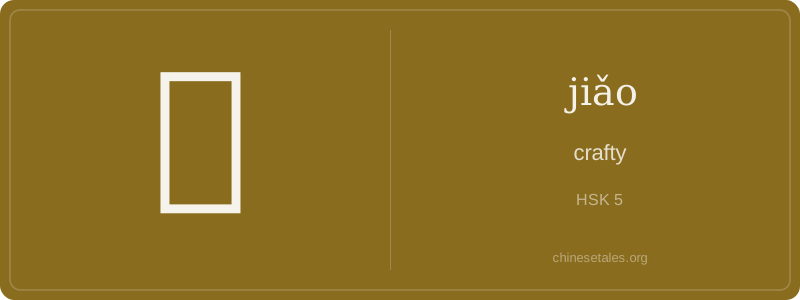
The earliest form of 狡 appears in Warring States bronze inscriptions as a combination of 犭 (a simplified dog/beast pictograph) and 交 (jiāo, 'to cross', 'to intertwine'). Originally, it wasn’t about foxes — it depicted a *tangled beast*, perhaps a snarling dog with limbs entwined, suggesting deceptive movement, evasiveness, or entrapment. Over centuries, the right side standardized into 交 (with its characteristic 'X'-shaped crossing strokes), while the left retained the three-stroke 犭 radical — no longer a full dog, but a clawed, alert presence. By the Han dynasty, the shape stabilized at nine strokes: three for 犭, then six for 交 (丿、一、丿、丶、丿、丶 — yes, that’s the precise stroke order!).
This visual logic became semantic truth: a beast that crosses paths deceptively — hiding, doubling back, feinting. By the time of the Shuō Wén Jiě Zì (121 CE), Xu Shen defined it as 'shàn yùn' (skilled at concealing), linking it directly to evasion. Its most famous classical appearance is in the Zhàn Guó Cè (Warring States Strategies), describing a minister who ‘以狡谋国’ (used crafty schemes to manipulate state affairs). The fox association solidified later — the idiom ‘狡兔三窟’ (a crafty rabbit has three burrows), from the same text, cemented the animal metaphor, turning the abstract ‘tangled beast’ into the enduring image of strategic, survivalist guile.
At its core, 狡 (jiǎo) isn’t just ‘clever’ — it’s clever with claws. The 犭 radical (‘dog’ or ‘beast’) immediately signals instinctive, animal-like cunning: not the admirable wisdom of 智 (zhì), but the sly, self-serving shrewdness of a fox slipping out of a trap. It carries faint moral weight — think 'wily' more than 'ingenious'. You’ll almost never see it alone; it’s strictly a compound character, always paired (e.g., 狡猾, 狡诈). Using it as a standalone adjective ('He is 狡!') sounds archaic or poetic — modern Mandarin requires the two-syllable form.
Grammatically, 狡 only appears in set phrases, mostly negative: 狡猾 (jiǎo huá, crafty), 狡诈 (jiǎo zhà, deceitful), or the literary 狡兔 (jiǎo tù, 'crafty rabbit' — referencing the idiom '狡兔三窟', 'a crafty rabbit has three burrows'). It’s never used positively like 聪明 (cōng ming, intelligent) and rarely modifies nouns directly without a preceding modifier (e.g., *not* '狡计划', but '狡诈的计划'). Learners often mistakenly insert it into neutral contexts — saying '他很狡' instead of '他很狡猾' — which sounds jarringly incomplete or even theatrical.
Culturally, 狡 taps into ancient Chinese zoology: the fox (狐) was the quintessential symbol of beguiling intelligence, especially in Tang dynasty tales and Ming-Qing vernacular fiction. But unlike Western 'sly fox' tropes, 狡 implies moral ambiguity — not mere cleverness, but cleverness deployed to evade consequences or manipulate others. That’s why it’s absent from formal praise (no one calls a diplomat 狡!) and common in political critique or detective fiction. Watch out: mispronouncing jiǎo as jiāo (like 交) erases the 'crafty' nuance entirely — it becomes meaningless noise.