疲
Character Story & Explanation
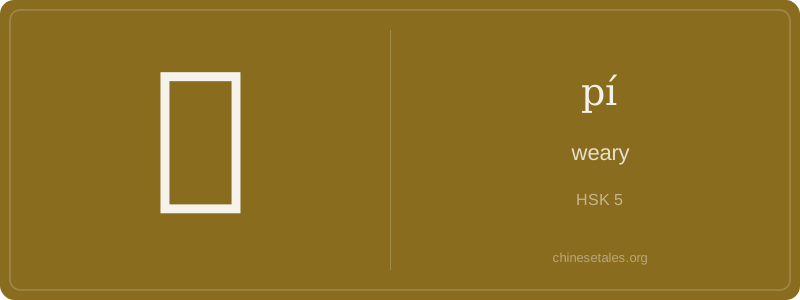
The earliest form of 疲 appears in Warring States bamboo slips as a compound: the sickness radical 疒 (depicting a person lying ill under a roof) paired with 皮 (pí, 'skin' or 'hide'). Originally, this wasn’t about skin — it was phonetic: 皮 provided the sound clue, while 疒 anchored the meaning in illness and debility. Over centuries, the top-left component simplified from a full ‘sickness bed’ pictograph into today’s compact 疒, and the right side stabilized as 皮 — retaining its role as a sound-borrowed element, not a semantic one.
This visual pairing — sickness + skin — subtly reinforced the idea of exhaustion that penetrates *beneath the surface*: not just muscle soreness, but a systemic depletion that shows up in pallor, trembling hands, or dull eyes. In the Shuōwén Jiězì (121 CE), Xu Shen defined 疲 as ‘extreme exhaustion causing inability to act’ — already emphasizing functional collapse, not mere drowsiness. By the Tang dynasty, poets like Du Fu used 疲 to describe war-worn soldiers and drought-stricken peasants, cementing its association with endurance pushed past human limits.
Think of 疲 (pí) as Chinese ‘burnout’ — not just tired, but the deep, bone-aching weariness that comes from sustained mental or physical strain, like a marathon runner hitting 'the wall' or a software engineer debugging at 3 a.m. Unlike English 'tired' (which can mean sleepy or mildly fatigued), 疲 carries clinical weight and emotional gravity — it’s the word doctors use in diagnoses (e.g., 慢性疲劳综合征, chronic fatigue syndrome) and poets use to evoke existential exhaustion.
Grammatically, 疲 is almost always an adjective, but it *never* stands alone before a noun like 'weary person'. You’ll see it in fixed compounds (疲乏, 疲劳) or after 很/非常 (e.g., 他很疲), or in the verb-like pattern 疲了 ('has become weary') — a subtle but critical distinction learners miss. Saying *‘疲人’* instead of *‘疲惫的人’* sounds jarringly unnatural, like saying ‘tired-person’ instead of ‘a tired person’ in English.
Culturally, 疲 appears frequently in modern workplace discourse — ‘过劳’ (overwork) and ‘职业倦怠’ (occupational burnout) both pivot on this character — making it far more socially loaded than its dictionary definition suggests. A common mistake? Confusing it with 怠 (dài, 'negligent') or 乏 (fá, 'lacking'), which lack the visceral, body-centered connotation of 疲’s 疒 radical. Remember: 疲 isn’t laziness — it’s the body shouting, ‘I’ve given everything.’