痒
Character Story & Explanation
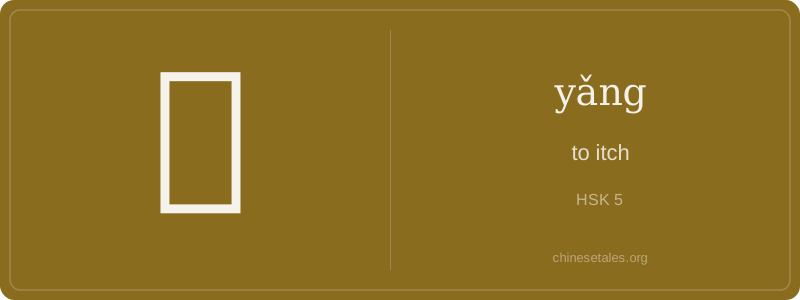
The earliest form of 痒 appears in Warring States bamboo slips, not oracle bones — and it’s brilliantly literal. The left side is 疒 (nè, ‘sickness radical’), unmistakably depicting a person lying ill under a roof. The right side? Not ‘羊’ as it looks today, but a stylized ‘養’ (yǎng, ‘to nourish’) — originally drawn with a hand holding a whip-like tool over a sheep, symbolizing care or tending. Over centuries, ‘養’ simplified into ‘羊’, making the character look like ‘sickness + sheep’ — a visual pun that stuck, even though the sheep has nothing to do with itching! By the Han dynasty, clerical script fused both parts tightly, and the 11-stroke modern form emerged with clear distinction: the ‘sick person’ frame cradling the ‘sheep’-shaped sound component.
Meaning-wise, 痒 began as a precise medical term in texts like the Huangdi Neijing, describing superficial, moving discomfort caused by external pathogens — distinct from deep, fixed pain (痛). Its association with restlessness and impatience grew gradually: Tang poets used ‘心痒’ to describe poetic inspiration bubbling up; Ming novels deployed ‘手痒’ for artisans aching to carve or paint. Crucially, the ‘sheep’ (羊) isn’t semantic — it’s purely phonetic (both 羊 and 痒 are yǎng), yet learners forever imagine woolly rashes. This homophone-driven evolution — where sound overrides image — is classic Chinese character logic at its most delightfully misleading.
Imagine you’re sitting in a quiet teahouse in Suzhou, sleeves rolled up, sipping jasmine tea — when suddenly, a faint, maddening tingle creeps up your forearm. Not pain, not heat — just that insistent, almost electric yǎng: the itch you can’t ignore but shouldn’t scratch in public. That’s 痒 in action: it’s not just physical sensation — it’s a visceral, involuntary *pull*, often with emotional or psychological layers. In Chinese, 痒 is almost always used predicatively (like an adjective) or in serial verb constructions: you don’t ‘have’ an itch like in English — you *are* yǎng, or *feel* yǎng, or *get* yǎng.
Grammatically, it rarely stands alone as a noun (unlike English ‘an itch’). You’ll hear it in structures like ‘身上很痒’ (shēn shàng hěn yǎng — ‘my body is very itchy’) or ‘痒得直抓’ (yǎng de zhí zhuā — ‘itching so badly I keep scratching’). Learners often mistakenly treat it like a noun and say ‘我有一个痒’ — which sounds bizarre, like saying ‘I have a redness’ instead of ‘I’m red’. Also, note: 痒 is almost never used metaphorically without context — ‘心痒’ (xīn yǎng) means ‘eager/itching to do something’, but only when paired with verbs like ‘想试’ or ‘难耐’; on its own, ‘心痒’ just means ‘heart itches’ — medically alarming!
Culturally, 痒 carries subtle tension between restraint and release. In classical medicine, it signaled ‘wind invading the skin’ — an imbalance needing gentle regulation, not vigorous scratching. Modern usage preserves that nuance: ‘痒’ implies something *just beneath the surface*, waiting to erupt — whether a rash, curiosity, or temptation. That’s why ‘手痒’ (shǒu yǎng) means ‘itchy hands’ — i.e., desperate to try or create — not a dermatological complaint!