眉
Character Story & Explanation
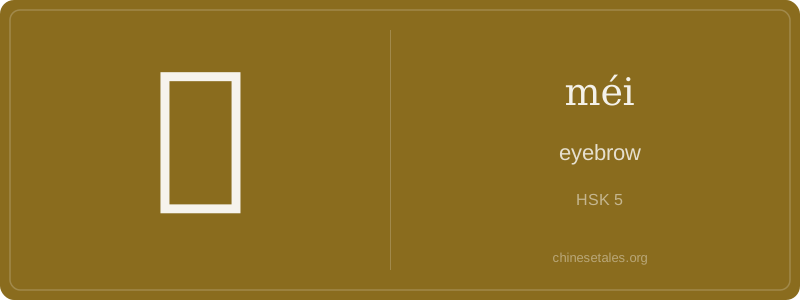
The earliest form of 眉 appears in oracle bone inscriptions (c. 1200 BCE) as a clear pictograph: two elegant, curved strokes arching over a simplified eye (目), with tiny vertical lines suggesting individual hairs—like calligraphic parentheses framing vision itself. Over centuries, the eye radical (目) stabilized at the bottom, while the top evolved from fluid brush curves into the crisp, symmetrical ‘尸 + 丿 + ㇏’ structure we see today—the upper part stylized into a roof-like ‘尸’ (shī, originally meaning ‘body’, but here purely phonetic/graphic) plus two graceful strokes mimicking brow contours. Even in seal script, the visual pun held: brows as the ‘roof’ sheltering the eye.
This visual logic anchored its meaning deeply. By the Warring States period, 眉 already carried metaphorical weight—Mencius wrote ‘存乎人者,莫良于眸子。眸子不能掩其恶。胸中正,则眸子瞭焉;胸中不正,则眸子眊焉’—and the brows were understood as the emotional heralds of the heart. In Tang poetry, ‘蛾眉’ (é méi) meant both ‘silkworm-arched brows’ and ‘a beautiful woman’ (as in Li Bai’s ‘众女嫉余之蛾眉兮’). The character never strayed from its dual identity: literal eyebrow and symbolic threshold between inner feeling and outer expression.
Imagine you’re watching a traditional Peking opera performer—her eyes are masked by heavy makeup, but her eyebrows dance: arched in disdain, furrowed in fury, lifted in playful surprise. In Chinese, it’s not just the eyes that speak—it’s the 眉 (méi), the eyebrow, that carries the subtlest emotional grammar. This isn’t just anatomy; it’s a cultural sensor. When someone says ‘他眉宇间透着自信’ (tā méi yǔ jiān tòu zhe zì xìn), they’re not describing facial hair—they’re reading confidence like ink on silk, written across the space between the brows.
Grammatically, 眉 rarely stands alone as a verb or adjective—it’s mostly noun-based, but shines in compound nouns and idioms. You’ll find it in subject position (‘眉头一皱’ — a frown flashes), in measure words (‘一眉’ is archaic, but ‘双眉’ is common), and crucially, in fixed expressions where dropping 眉 changes meaning entirely—e.g., ‘扬眉吐气’ (yáng méi tǔ qì) means ‘to lift one’s eyebrows and exhale triumphantly’: a whole posture of vindication. Learners often misplace it in verbs (saying *‘眉了’ instead of ‘皱眉’), forgetting it’s almost always bound to action verbs or nouns.
Culturally, 眉 is intimately tied to beauty standards (‘柳叶眉’ liǔ yè méi — willow-leaf brows), fate (‘眉寿’ méi shòu — a poetic term for long life, from the Book of Songs), and even divination (ancient face-readers judged character by brow shape). A common mistake? Using 眉 when you mean ‘eyelash’ (睫毛 jié máo) or ‘forehead’ (额头 é tóu)—but those are anatomically distinct zones. Also, don’t confuse its elegance with simplicity: this 9-stroke character holds more expressive weight per stroke than most HSK 5 characters.