眠
Character Story & Explanation
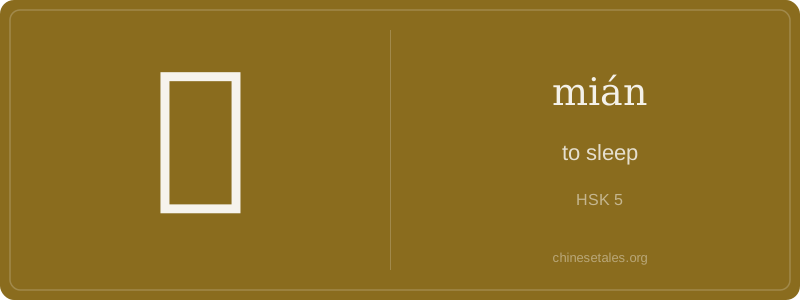
The earliest form of 眠 appears in seal script as a combination of 目 (eye) on the left and 民 (a simplified ancient form meaning 'people' or 'subject') on the right — but crucially, in oracle bone inscriptions, the right side resembled a kneeling figure with hands bound, later stylized into 民. The original pictograph showed an eye half-closed, perhaps with a downward stroke suggesting drooping lids — emphasizing the *visual state* of sleep onset. Over centuries, the right component evolved from a bound person to the modern 民, while the left 目 stayed constant, anchoring the meaning in vision — because sleep begins where sight fades.
This visual logic held firm: in the *Shuōwén Jiězì* (100 CE), Xu Shen defined 眠 as 'hé mù yě' (to close the eyes), making it fundamentally about ocular stillness — not unconsciousness per se, but the *act of shutting out the world*. That’s why it appears in classical idioms like 眠花宿柳 (to spend nights among flowers and willows — i.e., carousing), where 'sleep' implies temporary, sensory withdrawal. Even today, its radical 目 reminds us: 眠 isn’t just rest — it’s the moment your eyes surrender, and with them, your grip on reality.
Imagine it’s midnight in a Beijing apartment: rain taps the window, your friend yawns deeply, rubs her eyes, and murmurs, 'Wǒ yào shuì jiào le' — but then she pauses and corrects herself: 'Wǒ yào mián le.' Wait — why 'mián'? Because 眠 isn’t just generic 'sleep'; it’s the quiet, inward, almost poetic act of *falling into sleep* — eyes closing, consciousness softening, body yielding. It’s literary, formal, or medical (think 'insomnia' = 失眠), rarely used alone in casual speech like 睡. You’ll hear it in phrases like 昏昏欲眠 (drowsy to the point of dozing) or in compound verbs where it adds gravity: 入眠 (to enter sleep), 就眠 (to retire for sleep).
Grammatically, 眠 is almost always bound — it doesn’t stand solo as a verb in modern spoken Chinese (*I sleep* ≠ *wǒ mián*; you’d say *wǒ shuì jiào*). Instead, it shines in two-character compounds or with aspect particles: 他刚入眠就听见敲门声 (He had *just fallen asleep* when he heard knocking). Learners often overuse it trying to sound 'advanced', but native speakers reserve it for nuance — like choosing 'slumber' over 'sleep' in English. Also, it never takes objects (*mián yī gè hǎo jué* is unnatural; use 睡 instead).
Culturally, 眠 carries a gentle melancholy — classical poets used it to evoke solitude at dusk (e.g., Li Bai’s '夜深人靜,萬籟俱寂,唯餘孤燈照我眠'), and today it appears in clinical terms (失眠症), ads for melatonin ('助眠'), and even brand names ('眠之森' — Sleep Forest). Mistake alert: don’t confuse it with 睡 (shuì), which is neutral and colloquial — mixing them sounds oddly archaic or stiff, like saying 'I shall slumber' before ordering coffee.