瞎
Character Story & Explanation
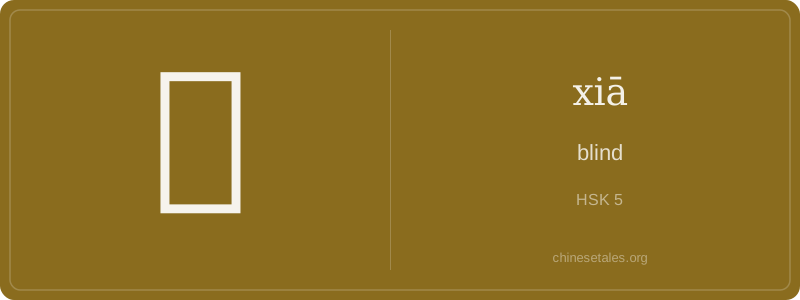
The earliest forms of 瞎 appear in seal script (c. 3rd century BCE), where it clearly combines 目 (mù, 'eye') on the left with 害 (hài, 'harm, damage') on the right — no pictograph of a damaged eye, but a conceptual compound: 'an eye harmed'. In oracle bone script, there’s no direct precursor, but by the Warring States period, scribes standardized the character to emphasize causation: the eye didn’t just fail — it was *damaged*. The 15 strokes evolved deliberately: the left 目 stays crisp and square (8 strokes), while the right 害 adds complexity — its upper part (宀 mián, 'roof') shelters 下 (xià, 'below'), but here it morphs into a tight, downward-pressing shape symbolizing oppression or injury to vision.
This structural logic carried into meaning: classical texts like the Zuo Zhuan use 瞎 metaphorically — e.g., describing a ruler who ‘cannot see the people’s suffering’ — long before it referred to physical blindness. By the Tang dynasty, it appears in poetry as both literal and figurative, and in vernacular novels like Water Margin, it’s already used adverbially (‘blindly obey’, ‘blindly fight’). The visual pairing of ‘eye’ + ‘harm’ wasn’t accidental — it encoded ancient insight: sight isn’t passive; it’s vulnerable, active, and morally charged.
At its core, 瞎 (xiā) means 'blind' — but it’s far more expressive than the clinical English word. It carries visceral, often colloquial weight: not just physical sightlessness, but foolishness, futility, or reckless ignorance. Think of it as the Chinese equivalent of 'blindly charging ahead' or 'shooting in the dark' — it’s rarely neutral. Grammatically, it functions most commonly as an adjective ('a blind person') or adverb ('blindly', as in 瞎忙 xiā máng — 'busy for no good reason'). Crucially, it’s almost never used in formal or medical contexts — you’d say 失明 (shīmíng) for clinical blindness; 瞎 belongs to speech, slang, and vivid storytelling.
One major learner trap is overgeneralizing its use. You can’t say *他瞎了* to mean 'he went blind' without context — that sentence sounds abrupt or even crude unless softened (e.g., 他眼睛瞎了 or more naturally, 他失明了). Also, 瞎 pairs powerfully with verbs to form vivid idioms: 瞎猜 (xiā cāi, 'guess blindly'), 瞎说 (xiā shuō, 'talk nonsense'), 瞎搞 (xiā gǎo, 'mess things up recklessly'). These aren’t literal translations — they’re cultural shorthand for actions done without sense, preparation, or awareness.
Culturally, 瞎 reflects a deep linguistic tendency to link perception with judgment. To be 'blind' isn’t just optical failure — it’s moral or intellectual failure. That’s why phrases like 瞎了眼 (xiā le yǎn, 'blinded my eyes!') express shock or disbelief — as if reality itself assaulted your ability to perceive truth. Learners often miss this emotional resonance and translate too literally, losing the exasperated, humorous, or self-deprecating tone native speakers effortlessly convey.