瞧
Character Story & Explanation
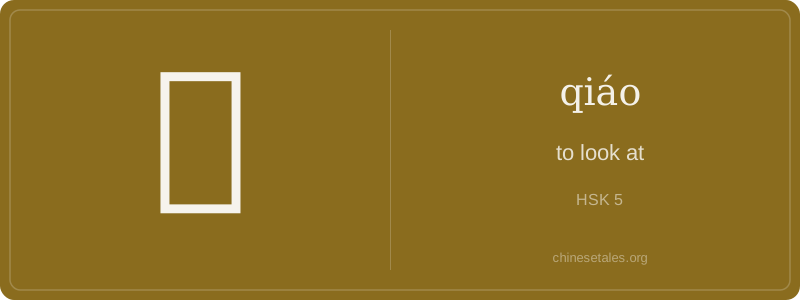
The earliest form of 瞧 appears in seal script (c. 3rd century BCE), where it combines 目 (mù, ‘eye’, the radical) on the left with 乔 (qiáo, ‘tall’, ‘lofty’) on the right — not as a phonetic loan, but as a semantic-phonetic compound. The 乔 component originally depicted a person standing on a high platform, arms raised — suggesting elevation, prominence, and therefore heightened perception. Over centuries, the top part of 乔 simplified from two trees (木木) to 喬, then further to 丿+冎+丨, while the 目 radical retained its eye-like box shape. By Song dynasty regular script, the 17 strokes stabilized into today’s balanced, upright form — eyes literally ‘looking up’ at something noteworthy.
This visual logic shaped its meaning: to look *with discernment*, not just glance. In classical texts, 瞧 appears rarely — it was a latecomer, emerging strongly in Ming-Qing vernacular fiction like The Plum in the Golden Vase, where characters say ‘你瞧’ mid-conversation to draw attention to irony or hypocrisy. Its rise mirrors the cultural shift toward valuing observational wit in daily speech — the character doesn’t just show eyes; it shows eyes *thinking aloud*.
‘瞧’ isn’t just ‘to look’ — it’s the raised eyebrow, the curious double-take, the gentle nudge of attention. In spoken Mandarin, it carries a warm, informal, often slightly playful or affectionate tone — think of a grandmother pointing at a toddler’s messy face and saying, ‘瞧你这小花猫样儿!’ (Look at you, you little kitty-cat!). Unlike neutral verbs like 看 or 观察, 瞧 implies personal engagement: you’re not passively receiving visual input; you’re leaning in, noticing something noteworthy, sometimes even with mild surprise or amusement.
Grammatically, 瞧 is almost always used in the imperative or present-tense colloquial register — rarely in formal writing or past-tense narrative without particles. You’ll hear it constantly in dialogue: 瞧瞧 (qiáo qiao, reduplicated for softness), 瞧见 (qiáo jiàn, ‘to catch sight of’), or as a sentence-final particle in northern dialects (e.g., ‘他来了,你瞧!’ — ‘He’s here — look!’). Learners often overuse it like English ‘look!’ but forget that 瞧 lacks the commanding force of 看 — it’s more inviting than instructive.
Culturally, 瞧 reflects the Chinese value of contextual awareness: seeing *with intention*, not just with eyes. It’s deeply tied to interpersonal rhythm — pausing to notice another person’s expression, gesture, or state. A common mistake? Using it in formal reports or academic texts (where 看 or 观察 belongs) or confusing its light tone with the sharper, more critical connotation of 瞅 (chǒu) or the clinical precision of 察 (chá).