石
Character Story & Explanation
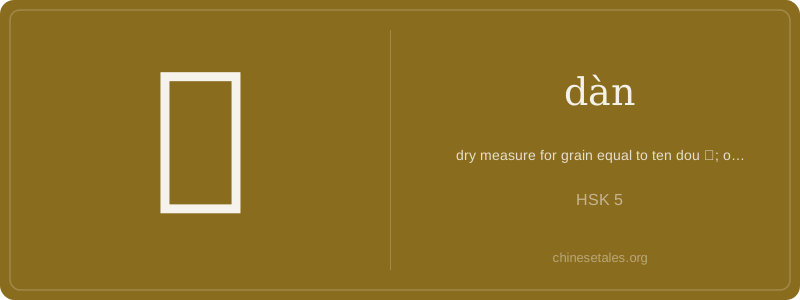
The earliest form of 石 appears in oracle bone inscriptions (c. 1200 BCE) as a pictograph of a stone nestled inside a container — two horizontal lines framing a small, jagged shape, suggesting a rock placed deliberately in a basket or storage pit. Over centuries, the ‘container’ simplified into the top component (the ‘lid’ stroke and horizontal bar), while the ‘rock’ evolved into the three downward strokes below — today’s distinctive five-stroke structure. By the Han dynasty seal script, the form had stabilized: the radical 石 was already both a semantic marker for stone-related concepts *and*, through phonetic loan, a stand-in for the measure word dàn.
This semantic leap — from literal stone to standardized grain volume — happened because early granaries used heavy stone weights to calibrate measures, and officials borrowed the familiar, solid character 石 to represent the fixed, unchanging unit itself. In the Rites of Zhou, ‘dàn’ is prescribed as the official measure for taxing millet and rice, cementing its bureaucratic role. The character’s visual heft — five strokes, angular and grounded — mirrors its function: stable, authoritative, immovable. Even today, when you write 石 (dàn), you’re tracing the outline of an ancient grain silo — not a boulder.
At first glance, 石 (dàn) looks like a simple unit — but it’s actually a cultural time capsule. While its radical 石 literally means 'stone', this particular reading (dàn) has nothing to do with rocks: it’s an ancient dry measure for grain, standardized since the Qin dynasty as exactly 10 dou (斗) or ~100 liters. To Chinese speakers, hearing ‘yī dàn mǐ’ instantly evokes imperial granaries, tax records, and rural harvests — not geology. The character’s dual identity (shí = stone; dàn = measure) is a classic example of how Chinese leverages homophony and context to pack layers of meaning into one glyph.
Grammatically, 石 (dàn) functions only as a noun measure word — never as a verb or adjective — and appears almost exclusively in formal, historical, or agricultural contexts. You’ll see it in phrases like ‘wǔ dàn xiǎo mài’ (five dan of wheat), but never in modern casual speech like ‘I bought some rice’. Crucially, it’s *not* interchangeable with modern metric units: saying ‘yī dàn shuǐ’ (one dan of water) sounds nonsensical — it only measures dry grains. Learners often mistakenly use it like ‘kilogram’, forgetting its strict semantic domain.
Culturally, 石 (dàn) reveals China’s deep-rooted agrarian bureaucracy: measurement wasn’t abstract math, but tied to land, labor, and state control. In the Book of Songs, ‘dàn’ appears in odes praising bountiful harvests, linking weight to virtue and stability. A common error? Confusing it with the measure word ‘jīn’ (catty) — mixing them up could turn a modest sack of grain into a ton of tax debt! Remember: 石 (dàn) is stone-shaped, but grain-measured — a quiet reminder that in Chinese, even numbers wear history’s clothes.