砍
Character Story & Explanation
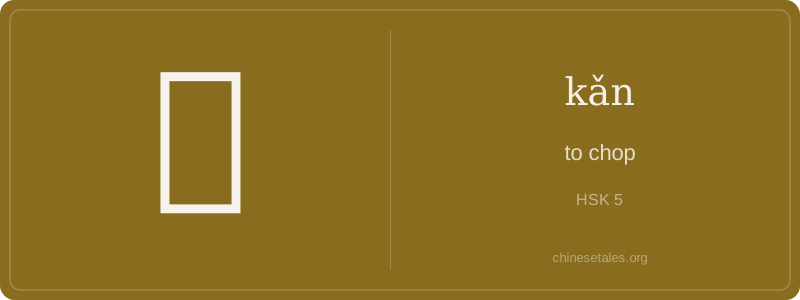
The earliest form of 砍 appears in bronze inscriptions as a combination of 石 (shí, ‘stone’) on the left and 欠 (qiàn, ‘to open mouth’ or ‘to raise head’) on the right — but that ‘欠’ was actually a stylized depiction of a person holding a heavy axe-like tool *over* stone, suggesting striking downward onto something hard. Over centuries, the right side evolved: 欠 simplified and merged with a phonetic hint (kan), while the left radical 石 remained — anchoring the character in materiality and weight. By the seal script era, the shape solidified into today’s 9-stroke form: 石 + 欠, with the top stroke of 欠 curving like a swinging arm, and the final stroke slashing diagonally like a blade’s follow-through.
This visual logic held firm across dynasties. In the *Shuōwén Jiězì* (121 CE), 砍 wasn’t yet included — it emerged later as a vernacular variant emphasizing forceful cutting, distinct from classical 刈 (yì, to reap) or 断 (duàn, to sever). By the Ming-Qing novels, 砍 was ubiquitous in martial scenes: ‘只见他大喝一声,举刀便砍’ (‘He roared and swung his sword down to chop!’). Its enduring power lies in that unbroken link between hand, tool, target, and gravity — a gesture so primal, it needed no philosophical gloss.
At its core, 砍 (kǎn) isn’t just ‘to chop’ — it’s the sharp, decisive *thunk* of a heavy blade meeting resistance: wood splitting, branches falling, even metaphorical barriers crumbling. Unlike gentler verbs like 削 (xiāo, to pare) or 切 (qiē, to slice), 砍 implies force, downward motion, and often finality — think chopping down a tree, not dicing onions. It’s an action verb that almost always takes a direct object (e.g., 砍树, 砍柴), and in modern Mandarin, it frequently appears in compound verbs like 砍掉 (kǎn diào, ‘to chop off/eliminate’) or passive constructions like 被砍了 (bèi kǎn le, ‘was chopped down’).
Grammatically, it’s wonderfully versatile but deceptively tricky. Learners often overuse it for any cutting action — but you wouldn’t say *kǎn yī kuài ròu* (‘chop a piece of meat’); that’s 切. 砍 needs weight, impact, and verticality. Also, note its tone: kǎn is third tone, and mispronouncing it as kān (first tone) could accidentally mean ‘to look’ (看) — a hilarious kitchen mix-up! And while it’s HSK 5, its compounds appear constantly in news (砍预算, ‘cut the budget’) and environmental discourse (砍伐森林, ‘deforest’), making it far more alive than textbooks suggest.
Culturally, 砍 carries faint echoes of martial precision and agrarian pragmatism — it’s the same verb used for executing orders (*kǎn tóu*, ‘behead’, now mostly literary) and pruning fruit trees. A common mistake? Assuming it’s interchangeable with 斩 (zhǎn), which is more formal, literary, and often implies moral judgment or state power (e.g., 斩首). 砍 stays grounded, earthy, and immediate — the sound of survival, not ceremony.