窄
Character Story & Explanation
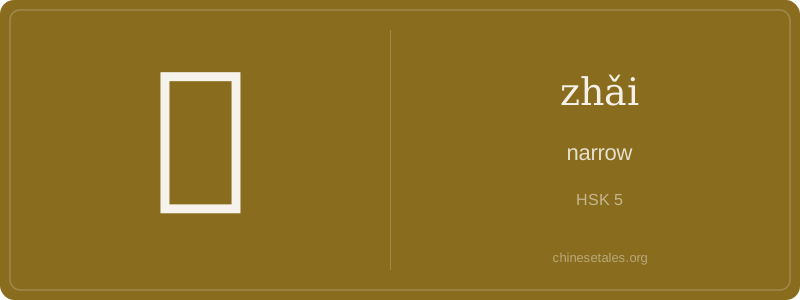
The earliest form of 窄 appears in seal script as a compound: the top half was 穴 (xué, 'cave' or 'hole'), and the bottom was 乍 (zhà), which originally depicted a tool striking downward — suggesting something forcibly compressed or constricted within a confined space. Over centuries, 乍 simplified into the current 又 (yòu) shape, while 穴 retained its roof-and-cavity structure. By the Han dynasty clerical script, the ten strokes had stabilized: the dot and roof strokes of 穴 above, then the three horizontal lines and hook of 又 below — visually echoing walls closing in.
This evolution mirrors its semantic journey: from concrete spatial restriction (a narrow cave entrance in early texts like the *Shuōwén Jiězì*) to broader applications like narrow paths, narrow margins, and eventually narrow opportunities. In classical poetry, 窄 often carried a quiet melancholy — Du Fu wrote of 'narrow sleeves' (窄袖) evoking both literal garment fit and metaphorical social constraint. Its enduring visual tension — a cavity 'squeezed' by 又 — makes it one of Chinese’s most intuitively felt ideographs: you don’t read it; you feel its walls.
At its core, 窄 (zhǎi) isn’t just a neutral descriptor like 'narrow' in English — it carries a subtle but pervasive sense of constraint, limitation, or even discomfort. Think of squeezing through a Beijing hutong alley at rush hour, or trying to fit your laptop into a cramped train overhead bin: the feeling is physical, spatial, and quietly stressful. That’s 窄 — not merely dimensional, but experiential.
Grammatically, it’s an adjective that usually precedes the noun (窄路, 窄门), but it can also follow 很/太/比较 for emphasis (这条路太窄了). Crucially, it’s rarely used for abstract 'narrowness' without qualification — you wouldn’t say *他思想窄* without context; instead, you’d say 思想狭隘 (xiá’ài) for 'narrow-minded'. Learners often overextend 窄 into psychological domains where native speakers prefer 狭隘, 小气, or 保守.
Culturally, 窄 reflects a deep-rooted spatial consciousness — from traditional courtyard house (siheyuan) design (where narrow side alleys signaled lower status) to modern urban anxiety about shrinking living space. The character itself lives inside the 'cave' radical (穴), subtly reinforcing how confinement feels elemental, almost primal. A common mistake? Using 窄 when describing time ('narrow schedule') — Chinese uses 紧 (jǐn) instead: 时间太紧了, never *时间太窄了.