立
Character Story & Explanation
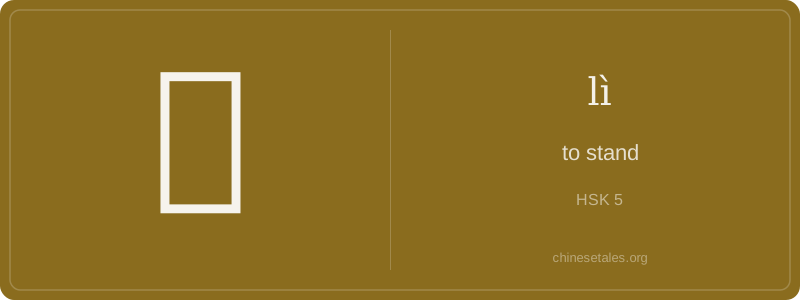
The earliest form of 立 appears in oracle bone inscriptions as a simple pictograph: a stylized human figure—head, torso, and two legs spread apart—standing upright on a horizontal line representing the ground. Over time, the head became a dot or short horizontal stroke (丶), the torso a vertical line (丨), and the legs evolved into two downward-sloping strokes (丿 and ㇏), forming today’s elegant, balanced five-stroke structure. Crucially, no arms — this isn’t dancing or reaching; it’s pure, unwavering verticality.
This visual clarity anchored its meaning: 'to stand' as both physical posture and metaphorical foundation. By the Warring States period, 立 was already used abstractly — Mencius wrote '三十而立' (sānshí ér lì), 'At thirty, one stands' — meaning moral and intellectual self-establishment. The character’s stability mirrors its semantic role: it’s the root for 'establishing' rituals, laws, dynasties, even surnames. Its very shape — compact, grounded, symmetrical — whispers authority before you even read it.
Think of 立 (lì) as Chinese’s version of the word 'stand' — but not just physically. Like the English phrase 'to stand firm' or 'stand up for justice', 立 carries moral weight and agency: it’s about taking a position, making a commitment, or establishing something real. In English, 'stand' is mostly physical or idiomatic; in Chinese, 立 is grammatically *productive* — it appears in dozens of verbs and compounds where English uses entirely different roots (e.g., 立法 lìfǎ 'to legislate', not 'to law-make').
Grammatically, 立 is rarely used alone in modern speech (unlike English 'stand'), but shines as a verb prefix or core morpheme. It can’t take aspect particles like 了 or 过 directly — you’d say 立下了誓言 (lì xià le shìyán, 'made a vow'), not *立了誓言. Learners often mistakenly treat it like a standalone action verb ('I stand here') — but that’s better expressed with 站 (zhàn). 立 feels formal, decisive, almost ceremonial.
Culturally, 立 echoes Confucian ideals: to 'establish oneself' (立身 lìshēn) means cultivating virtue and reputation; to 'establish a family' (立家 lìjiā) implies social responsibility, not just cohabitation. A classic mistake? Using 立 instead of 站 when ordering coffee — 'I’ll stand here' said with 立 sounds like you’re declaring sovereignty over the café floor!