股
Character Story & Explanation
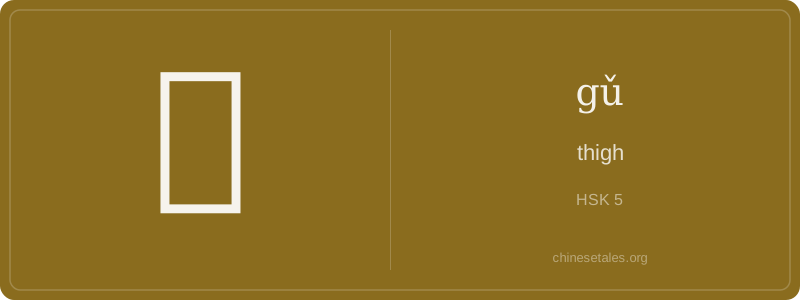
The earliest form of 股 appears in bronze inscriptions as a pictograph combining ⺼ (flesh/body) with 尸 (shī, a crouching person). Imagine a stylized side view: the curved line of 尸’s bent back and legs, with ⺼ added beside it to emphasize the muscular thigh region. Over centuries, 尸 simplified into 月 (the 'moon' radical, which here is actually a corrupted form of ⺼ in many characters), while the right-hand component evolved from 告 (gào) — not for 'telling', but as a phonetic clue preserving the gǔ sound. By the seal script era, the shape had stabilized: ⺼ on the left, 侯 (hóu)’s top part (later miswritten as 侯 without the 'mouth') became the right side — though modern dictionaries list the right as 侯 minus 口, making it look like 'flesh + marquis', a delightful visual coincidence.
This character’s semantic journey is a masterclass in metaphorical extension. In the Shuōwén Jiězì (121 CE), Xu Shen defined 股 as 'the part between the waist and knee' — strictly anatomical. But by the Tang dynasty, it was already used in military texts for 'a division of troops', evoking the thigh’s role as a strong, unified segment of the body. The stock-market usage emerged only in the 20th century, borrowing the idea of a 'portion' or 'share' — not of land or grain, but of ownership — again anchored in the image of something substantial, divisible, yet structurally integral. Its shape still whispers 'flesh + authority' — fitting for both anatomy and equity.
At its core, 股 (gǔ) means 'thigh' — but don’t picture just anatomy. In Chinese thought, the thigh is the sturdy pillar of the lower body: powerful, foundational, and quietly essential. That physical solidity bled into abstract uses early on — by the Han dynasty, 股 already appeared in phrases like 股肱 (gǔ gōng), meaning 'thigh and upper arm', metaphorically 'trusted ministers' who support the ruler like limbs support the body. This embodied logic — where body parts map directly to social roles — reveals how deeply Chinese conceptualizes power, loyalty, and structure through the lived experience of the human form.
Grammatically, 股 is surprisingly versatile. As a noun, it’s straightforward ('his left thigh'), but as a measure word, it’s indispensable for slender, flexible, or bundled things — not just 'shares' (as in stocks), but also 'a股 of smoke', 'a股 of wind', or 'a股 of rope'. Learners often overgeneralize it as 'a piece of' — but no: you wouldn’t say *一股份* for 'a piece of paper' (that’s 张). It’s about *cohesive, linear continuity*, like muscle fibers or stock ownership units.
Culturally, the leap from 'thigh' to 'stock share' (gǔpiào) isn’t random — it reflects how financial systems in late imperial and modern China borrowed organic, bodily metaphors to make abstract capital feel tangible and accountable. A common mistake? Pronouncing it as gū or gù — but the tone is firmly third (gǔ), matching words like 鼓 (drum) and 古 (ancient), both sharing that deep, resonant, grounded quality. Mispronouncing it risks sounding like 'ancient thigh' — oddly poetic, but not helpful at the stock exchange.