肌
Character Story & Explanation
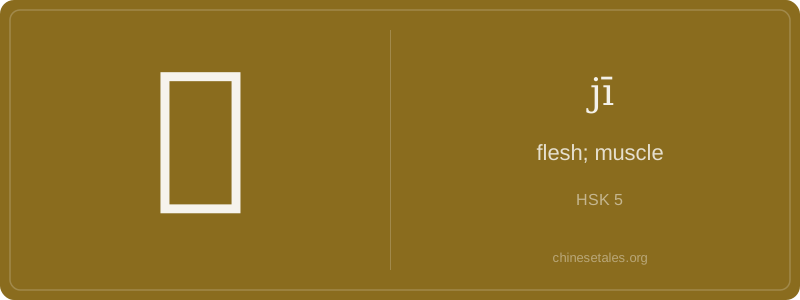
The earliest form of 肌 appears in Warring States bamboo slips as a combination of ⺼ (flesh radical, originally a pictograph of hanging meat cuts) and 几 (jī, 'small table' — used phonetically). Oracle bone script didn’t have 肌 yet; it emerged later as writing standardized. Visually, the modern form preserves the left-side ⺼ (6 strokes total: the radical plus the right component 几 — two strokes for the horizontal and hook, plus the dot and stroke inside, totaling six). The right side 几 was chosen purely for sound — its ancient pronunciation matched the word for 'flesh', making this a classic phono-semantic compound.
Originally, 肌 referred specifically to the thin, fibrous layers beneath skin — distinct from 肉 (ròu, general flesh/meat) and 筋 (jīn, tendons). By the Han dynasty, it appeared in medical texts describing defensive bodily layers; by the Tang, poets like Du Fu used 肌理 metaphorically to mean 'fine grain' — comparing poetic texture to muscle fiber. This dual physical/metaphorical life persists today: when a calligrapher praises a brushstroke’s 'strong 肌理', they’re praising its organic, living density — not just its shape.
Imagine you’re at a traditional Chinese medicine clinic, and the doctor gently presses your forearm while saying, 'Your 肌 (jī) feels tight — there’s stagnant qi here.' In that moment, 肌 isn’t just ‘muscle’ like in a gym brochure; it’s the living, breathing interface between skin and bone — the soft tissue layer where health is palpated, where acupuncture needles find their home, and where fatigue literally settles. In Chinese, 肌 carries a holistic, almost tactile weight: it implies *flesh with function*, not just anatomy. You’ll rarely see it alone — it’s nearly always in compounds like 肌肉 (jīròu, 'muscle') or 皮肤 (pífū, 'skin'), never as a standalone noun meaning 'a muscle' the way English speakers might say 'I pulled a muscle.'
Grammatically, 肌 is strictly a bound morpheme — it refuses to go solo. It appears in technical, medical, or literary contexts: 肌理 (jīlǐ, 'muscle texture/fiber grain') describes both marble veining and poetic structure; 肌肤 (jīfū, 'skin and flesh') evokes delicate beauty in classical poetry. Learners often mistakenly use 肌 where they need 肉 (ròu, 'meat/flesh') — e.g., ordering food ('I want chicken muscle' instead of 'chicken meat') — which sounds bizarrely clinical, like ordering lab specimens.
Culturally, 肌 ties deeply to traditional views of the body as an integrated system: in texts like the Huangdi Neijing, 肌 is one of the 'five tissues' (五体), linked to the Spleen and governing defense against external pathogens. Its radical ⺼ (‘flesh’) signals embodied experience — this isn’t abstract biology. That’s why you’ll hear 肌肤 used in romance novels ('her smooth 肌肤') but never in fast-food menus. The character quietly insists: flesh isn’t inert — it breathes, remembers, and reveals.