肃
Character Story & Explanation
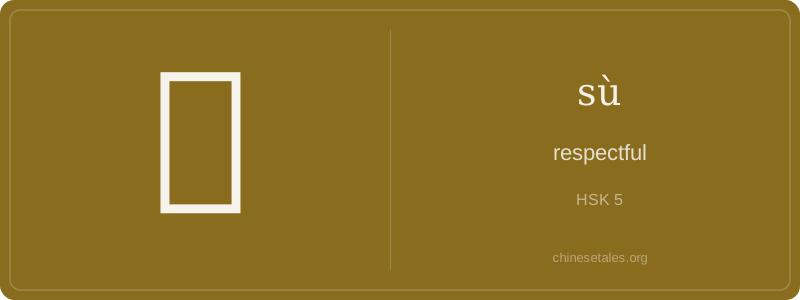
The earliest form of 肃 appears in bronze inscriptions as a stylized figure kneeling with arms folded tightly across the chest — a posture of deep ritual submission. Over centuries, the top evolved into the radical 肀 (a variant of 入 ‘enter’, here suggesting inward focus), while the lower part condensed from a kneeling human (卩) plus hands (又) into today’s simplified 丨 + 丿 + 丶 strokes — eight strokes total, mirroring the discipline it represents.
This visual discipline shaped its meaning: from physical stillness → moral seriousness → institutional rigor. In the Classic of Filial Piety, 肃 describes the reverent demeanor one must maintain before elders; by the Tang dynasty, it appears in bureaucratic documents meaning ‘to enforce order strictly’. Notice how the character itself looks upright, unadorned, and unyielding — no curves, no flourishes — a perfect visual echo of its semantic core: respect that wears no smile.
At its heart, 肃 (sù) isn’t just ‘respectful’ — it’s the quiet gravity of a bowed head in silence, the hush before a ceremony begins, the unwavering dignity of someone holding themselves with solemn composure. It conveys reverence *and* austerity, often implying seriousness so deep it borders on sternness or even austerity — think of a judge’s courtroom or a Confucian ancestral hall, not a friendly handshake.
Grammatically, 肃 is almost never used alone as a verb in modern Mandarin. Instead, it shines in compound adjectives (e.g., 肃穆 sùmù ‘solemn and reverent’) and verbs like 肃清 (sùqīng ‘to thoroughly purge/cleanse’) — where it adds moral weight and decisive rigor. Learners often mistakenly try to say ‘I am respectful’ as *wǒ hěn sù*, but that’s ungrammatical; you’d say 我很恭敬 (wǒ hěn gōngjìng) or use 肃 only in set phrases like 严肃 (yánsù ‘serious’), where it’s inseparable from its partner.
Culturally, 肃 carries echoes of ritual propriety (lǐ 礼) from classical texts like the Book of Rites. Its austerity can shade into political gravity — e.g., 肃反 (sùfǎn ‘suppress counter-revolutionaries’) — so tone matters deeply. A common error is overusing it in casual speech: saying 肃静 (sùjìng) to shush friends feels like invoking imperial protocol! Reserve it for contexts demanding gravitas — ceremonies, official notices, or literary description.