耽
Character Story & Explanation
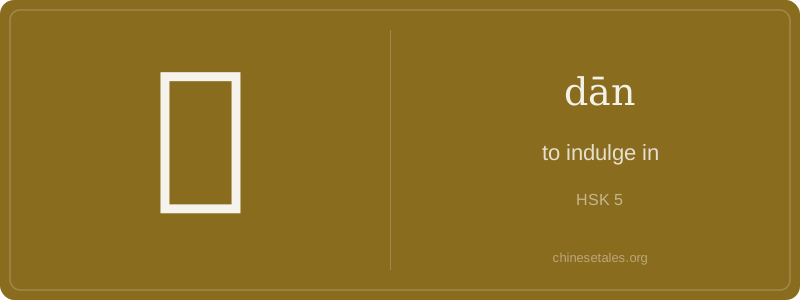
The earliest form of 耽 appears in bronze inscriptions as a pictograph combining 耳 (ear) and 冘 (yín, an ancient variant of 冉, depicting something hanging down). Imagine an ear with a long, drooping tassel or pendant — visually suggesting 'something clinging to the ear,' symbolizing how pleasure or obsession *hangs on*, refusing to let go. Over centuries, the lower part evolved from 冘 into 亠 + 冉, then simplified into today’s 10-stroke structure: 耳 on top (not left!) and a stylized 'hanging' component beneath — making it one of only a few characters with 耳 as a top radical.
This visual metaphor deepened semantically: by the Warring States period, 耽 appeared in the Book of Songs (Shījīng) — '耽于酒色' (dān yú jiǔ sè) — describing rulers lost in wine and beauty. The 'hanging ear' became a poetic image for attention that won’t lift away. Even today, its shape whispers 'what’s caught on your ear?' — a perfect visual anchor for 'what’s holding your mind hostage.'
At its core, 耽 (dān) carries a gentle but insistent weight — not mere 'delay' or 'waste,' but the quiet, almost luxurious pull of indulgence: losing yourself in music, binge-watching dramas, or lingering over a cup of tea long past practicality. It’s about *voluntary* absorption, often with a hint of self-awareness — like smiling at your own distraction. Unlike neutral words like 拖 (tuō, 'to delay'), 耽 implies emotional investment and pleasurable suspension of duty.
Grammatically, it’s almost always transitive and appears in formal or literary contexts — rarely in casual speech. You’ll see it in structures like 耽于… (dān yú…, 'indulge in…'), 耽误 (dān wù, 'to delay/impede' — note this is a compound where 耽 has softened to mean 'cause delay'), or standalone in classical-style expressions like 耽乐 (dān lè, 'indulge in pleasure'). Crucially, it never takes aspect markers (了, 过) directly — you’d say 他耽于幻想 (tā dān yú huàn xiǎng), not *他耽了于幻想.
Culturally, 耽 echoes Confucian unease with excessive personal pleasure — it’s often used with subtle disapproval, especially when duties are neglected. Learners mistakenly use it for simple 'delay' (e.g., *火车耽了 — wrong! Use 误点了); others confuse it with similar-looking characters like 枕 or 沈. Remember: 耽 is about *emotional immersion*, not mechanical lateness.