胡
Character Story & Explanation
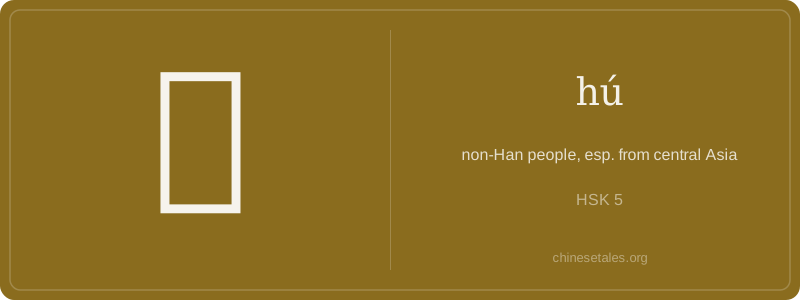
The earliest form of 胡 appears on Warring States bronze inscriptions—not as a pictograph, but as a phonosemantic compound already. Its left side ⺼ (a variant of 月, 'flesh') signals bodily or human-related meaning; its right side 古 (gǔ, 'ancient') serves as the phonetic clue. Wait—why 'ancient'? Because in Old Chinese, *gū* sounded close to *gâ*, the reconstructed pronunciation of 'Hu'. Over centuries, the flesh radical subtly shifted from 月 to ⺼ (a standard variant), while 古 stayed stable—no dramatic visual metamorphosis, just quiet phonetic loyalty and semantic drift.
This character entered written records around the Qin–Han transition, precisely when the Xiongnu confederation became China’s defining 'other'. Sima Qian’s Records of the Grand Historian uses 胡 repeatedly for them—and crucially, for their customs: 胡服 (húfú, 'nomadic clothing') and 胡乐 (húyuè, 'steppe music'). The flesh radical wasn’t about anatomy—it signaled 'human group', anchoring the term in lived, embodied difference. Later, during the cosmopolitan Tang, 胡 softened into cultural shorthand: 胡饼 (húbǐng, 'flatbread') was street food, not an insult. The character didn’t change shape—but its cultural charge did: from frontier threat to culinary delight.
At its core, 胡 (hú) carries the historical weight of 'otherness'—specifically, non-Han peoples from Central and North Asia (like the Xiongnu, Turks, or Sogdians). It’s not neutral: it’s a Han-centric label with faint echoes of ancient frontier tension, like calling someone 'barbarian' in classical Greek—but with far more cultural baggage. Today, it’s mostly frozen in historical terms or compound words; you won’t use it alone to refer to modern ethnic groups (that would be inappropriate and outdated).
Grammatically, 胡 rarely stands solo. Instead, it shines in fixed compounds: as a prefix meaning 'non-Han' (e.g., 胡人 húrén 'Central Asian person'), or in idioms like 胡说 (húshuō) 'to talk nonsense'—where it’s lost its ethnic sense and gained a pejorative flavor of 'illogical, foreign-sounding, therefore unreliable'. Yes—the same character that once named real Silk Road merchants now means 'bulls**t'! Learners often mistakenly use 胡 as a general word for 'foreign', but it’s *not* interchangeable with 外 (wài) or 洋 (yáng); using 胡 to describe French people (e.g., *胡人* for French) would sound archaic, offensive, or comically wrong.
Culturally, 胡 is a linguistic time capsule. Its persistence in food terms (胡椒 hújiāo 'black pepper', originally from India via Central Asia) quietly maps ancient trade routes—every bite of pepper is a taste of the Tang Dynasty’s cosmopolitanism. A common mistake? Overgeneralizing its 'foreign' meaning: 胡琴 (húqín) isn’t just 'any foreign string instrument'—it specifically refers to bowed lutes introduced by northern nomads, like the erhu. Respect the history—or risk sounding like you’re quoting a 7th-century border garrison.