胸
Character Story & Explanation
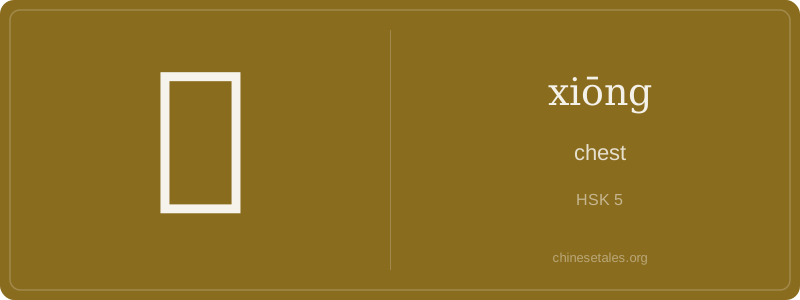
The earliest form of 胸 appears in seal script (c. 3rd century BCE), built from the radical ⺼ (a variant of 月, meaning 'flesh' or 'body part') on the left and 兇 (xiōng, 'ferocious' or 'ominous') on the right—a phonetic component that also subtly echoed danger or intensity, perhaps referencing the vulnerability of the chest area in combat or ritual. Over centuries, 兇 simplified: its top dot vanished, the ‘X’ shape (凶) streamlined into 凶, and the bottom ‘crossroads’ (㐅) evolved into the modern 凶’s square frame—while ⺼ remained steadfast, anchoring the character in the body.
This visual pairing wasn’t arbitrary: ancient texts like the Huangdi Neijing (Yellow Emperor’s Classic of Medicine) described the chest as the ‘gate of qi’—where breath, spirit (shén), and emotional energy converge. By the Tang dynasty, poets like Du Fu used 胸 explicitly for inner resolve: ‘胸中块垒’ (xiōng zhōng kuài lěi)—literally ‘lumps in the chest’—to describe unexpressed frustration or righteous indignation. The character’s structure thus encodes a profound idea: what we carry *inside our chest*—whether breath, courage, or sorrow—is where humanity meets physiology.
At its core, 胸 (xiōng) isn’t just anatomy—it’s the emotional and moral center of the Chinese body-mind landscape. Unlike English ‘chest’, which is largely physical, 胸 carries warmth, courage, and inner truth: think 胸有成竹 (xiōng yǒu chéng zhú, 'bamboo in the chest')—a vivid idiom meaning 'to have a well-thought-out plan', evoking mental clarity as something grown and held *within* the chest itself. This reflects the traditional Chinese view of the heart-and-chest region as the seat of intention and moral conviction—not just lungs or ribs.
Grammatically, 胸 rarely stands alone in speech; it’s almost always part of compounds (e.g., 胸口, 胸部, 胸怀). You won’t say *‘my chest hurts’* with bare 胸—you’d say 胸口疼 (xiōng kǒu téng) or 胸部不适 (xiōng bù bù shì). Learners often mistakenly use 胸 like an English noun ('I touched his chest'), but native speakers prefer 胸口 (the front surface), 胸部 (the anatomical region), or even 胸膛 (xiōng táng, the broad, vital ‘thorax’ with poetic weight).
Culturally, 胸 appears in expressions that reveal deep values: 胸怀宽广 (xiōng huái kuān guǎng, 'broad-chested' → magnanimous) links physical openness to moral generosity, while 胸无点墨 (xiōng wú diǎn mò, 'no ink in the chest') humorously accuses someone of having no literary cultivation—ink isn’t on paper, but *in the chest*. A common learner trap? Using 胸 when you mean ‘breast’ (that’s 乳房 rǔ fáng); 胸 is neutral, clinical, or figurative—not intimate or gendered.