卧
Character Story & Explanation
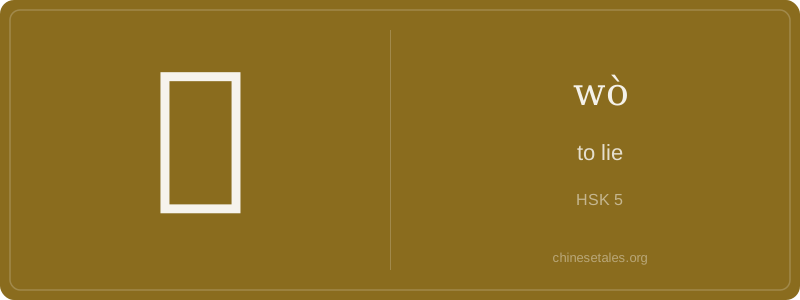
The earliest form of 卧 appears in bronze inscriptions as a vivid pictograph: a person (人) lying sideways on a mat or platform, with arms folded and head resting — often stylized with a bent leg and clear horizontal orientation. Over time, the ‘person’ component simplified into the left-side radical 臣 (chén), which originally depicted a kneeling servant’s wide-eyed, submissive profile — but here, it was borrowed purely for its horizontal, grounded shape and phonetic hint (ancient pronunciation overlapped with wò). The right side, 人 (rén), gradually morphed into ㇒ + 丶, then standardized into today’s 人-like stroke cluster — preserving the sense of a body at rest, anchored low to the earth.
This visual logic endured: 卧 always implied horizontal positioning — whether for healing (as in classical medical texts like the Huangdi Neijing), concealment (as in military strategy: 卧底 wò dǐ, ‘deep cover agent’), or humility (Confucius praised the sage who could ‘lie low and observe the Dao’). Its enduring power lies in that paradox: a character born from submission became the ultimate symbol of strategic stillness — the kind that waits, watches, and ultimately rises.
At its core, 卧 (wò) isn’t just ‘to lie down’ — it’s the quiet, intentional act of reclining *with purpose*: resting, recovering, hiding, or even plotting. Unlike 躺 (tǎng), which is neutral and physical (‘to lie flat’), 卧 carries weight — it’s literary, classical, and often implies stillness with intention or vulnerability. You’ll find it in poetry, medical texts (卧床休息 wò chuáng xiūxī — 'bed rest'), and idioms like 卧薪尝胆 (wò xīn cháng dǎn — 'sleep on firewood and taste gall', i.e., endure hardship to prepare for revenge).
Grammatically, 卧 is almost always transitive or used in compound verbs — it rarely stands alone as a main verb in modern speech. You won’t say *‘I wò’*; instead, you say 卧床 (wò chuáng, 'lie in bed'), 卧倒 (wò dǎo, 'fall prone'), or 卧室 (wò shì, 'bedroom') — where it functions as a semantic anchor meaning ‘reclining-related’. It’s also common in passive or descriptive constructions: 他卧在沙发上 (Tā wò zài shāfā shàng — 'He lies on the sofa'), emphasizing posture over action.
Culturally, 卧 appears in Daoist and Chan Buddhist contexts to signify surrender to stillness — not laziness, but mindful repose. Learners often mispronounce it as ‘wō’ (like 窝) or confuse it with 坐 (zuò, ‘to sit’) — but more dangerously, they overuse it trying to sound ‘literary’, when native speakers prefer 躺 or 靠 in casual speech. Also, note: 卧 never means ‘to sleep’ — that’s 睡 (shuì). Confusing them makes your sentence sound archaic or oddly solemn… like announcing ‘I shall recline’ before napping.