临
Character Story & Explanation
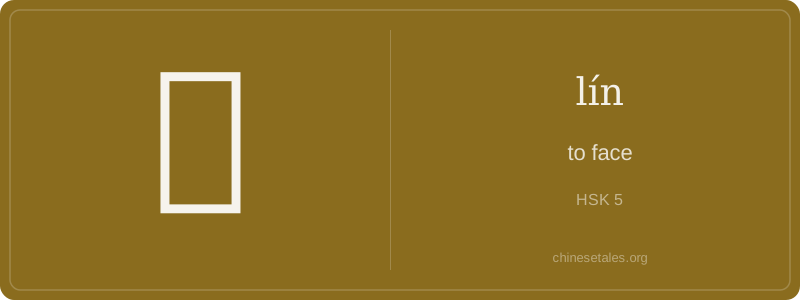
The earliest form of 临 appears in bronze inscriptions as two eyes (丨丨, simplified later to 丨) above a kneeling figure (the bottom part, now written as 廴 + 丿). Wait — actually, scholars now agree the top wasn’t eyes but a stylized representation of *a person standing on high ground*, gazing down: the vertical stroke (丨) symbolizes the upright body, while the three strokes beneath evolved from a platform or cliff edge. Over centuries, the platform morphed into 廴 (a bent path) and 丿 (a downward sweep), capturing motion *toward* what’s below — thus, ‘facing from above’.
This vantage-point origin explains why 临 so often implies authority, oversight, or inevitability: in the *Zuo Zhuan*, rulers ‘临政’ (govern from above); in poetry, one ‘临风’ (faces the wind — standing tall on a height). Even today, 临终 (at death’s threshold) preserves that sense of standing at a boundary. The character doesn’t just show position — it encodes perspective as power, and presence as responsibility.
At its heart, 临 (lín) isn’t just ‘to face’ — it’s about presence with weight: standing before something consequential — a cliff, a ruler, a crisis, or even death. It carries gravity, not casual attention. You don’t ‘face’ your coffee with 临; you 临危不惧 (remain calm when facing danger) or 临摹 (copy calligraphy by standing beside the master’s original). That ‘standing beside’ nuance is key: it implies proximity, observation, and readiness — never passive looking.
Grammatically, 临 shines in formal, literary, or compound constructions. As a verb, it often appears in classical-style phrases (e.g., 临别赠言 — farewell words spoken at parting), and as a prefix meaning ‘imminent’ (e.g., 临近高考 — approaching the Gaokao). Learners mistakenly use it like 看 (to look) or 面对 (to confront); but 临 demands solemnity and spatial/psychological nearness — no colloquial ‘I’m facing my deadline’ unless you’re writing a Tang dynasty poem.
Culturally, 临 reflects the Confucian value of *jing* (reverent attentiveness): standing respectfully before elders, tradition, or moral thresholds. A common error? Overusing it in speech — native speakers rarely say *wǒ lín zhe chuāng* (‘I face the window’); they’d say *wǒ kàn zhe chuāng*. Reserve 临 for moments charged with consequence, ceremony, or classical resonance — that’s where its power lives.