舅
Character Story & Explanation
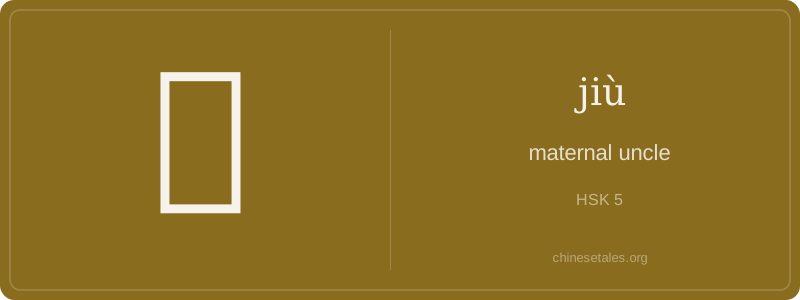
The earliest form of 舅 appears in bronze inscriptions around 1000 BCE — not as a person, but as a composite: a kneeling figure (the ancient form of 臼, originally depicting a mortar but repurposed here as a phonetic component) paired with 夕 (xī), an old variant of 多, suggesting repetition or abundance — hinting at the uncle’s role as a recurring, supportive presence in the maternal line. Over centuries, 夕 evolved into 男 (nán, male) in seal script, then simplified to the modern top-right 月 (a radical variant of 肉, implying flesh/kinship), while 臼 stayed anchored at the bottom — its hollow shape now evoking both a mortar and the ‘hollow’ space between generations that the uncle bridges.
This visual evolution mirrors semantic deepening: in the *Book of Rites*, 舅 appears alongside 姑 (maternal aunt) as vital ritual anchors — the ‘two pillars’ of the bride’s natal family. Confucian texts emphasize that a daughter’s 舅 must formally receive her wedding gifts, symbolizing his enduring authority over her welfare. The character’s stubbornly non-phonetic structure — 臼 gives no sound clue (jiù ≠ jiù from 臼!) — shows how orthography prioritized social function over phonology: this wasn’t just a word, it was a contract written in ink.
Imagine you’re at a bustling family reunion in Chengdu — aunties are steaming dumplings, uncles are arguing about Sichuan opera, and your mom gestures to a man with kind eyes and a slightly rumpled shirt: ‘That’s your jiùjiu.’ Not just ‘uncle’ — specifically your mother’s brother. In Chinese, 舅 (jiù) isn’t a generic term like English ‘uncle’; it’s precise, relational, and loaded with kinship gravity. It’s always maternal — never paternal (that’s 伯 or 叔). This precision reflects how deeply Chinese kinship maps bloodlines: your 舅 shares your mother’s surname, often her childhood home, and carries ceremonial weight — he might preside over your wedding or present gifts during Spring Festival.
Grammatically, 舅 is almost always used with reduplication (舅舅) for familiarity, or with kinship suffixes like 舅父 (jiùfù, formal) or 舅妈 (jiùmā, his wife). You’ll rarely see it bare — saying just ‘我舅’ sounds abrupt, like saying ‘my uncle’ without context in English. Learners often mistakenly use it for paternal uncles or drop the reduplication in casual speech, which can unintentionally sound cold or bureaucratic.
Culturally, the maternal uncle holds a quietly powerful role: historically, he was a key protector and advisor when a daughter married out — bridging her natal and marital families. Today, many urban Chinese still consult their 舅 on big decisions, and in some southern dialects, 舅 is even used metaphorically for trusted mentors. A fun trap? The character looks like it contains ‘old’ (臼), but that’s pure coincidence — it’s not about age, it’s about lineage.