良
Character Story & Explanation
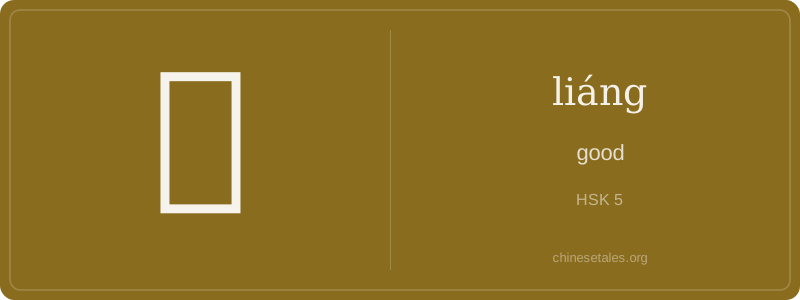
The earliest form of 良 appears in oracle bone inscriptions as a stylized depiction of an open eye with a prominent pupil — ️ — symbolizing 'clear sight' or 'perception'. Over time, this evolved into bronze script with a simplified eye shape above a horizontal line, then into seal script where the top became two short strokes resembling eyelashes, and the bottom transformed into the radical 艮 (gèn), which originally meant 'to stop' or 'stillness' — together suggesting 'clarity that leads to wise stillness'. By the Han dynasty clerical script, the character settled into its modern 7-stroke form: two dots (the 'eyelashes'), a horizontal stroke (the brow), a vertical stroke (the nose bridge), and the 艮 base (the grounded, discerning mind).
This visual origin explains why 良 conveys 'good' not as mere positivity, but as *discerned excellence* — the kind praised in the Analects (《论语》): 'The gentleman is not a vessel' (君子不器), implying depth, integrity, and innate virtue. Mencius later wrote 'The heart of compassion is the beginning of benevolence; the heart of shame is the beginning of righteousness; the heart of deference is the beginning of propriety; the heart of right and wrong is the beginning of wisdom' — and all four hearts are described using 良 (e.g., 良心, 'good conscience'). Its shape remains a quiet reminder: true goodness begins with clear seeing.
Think of 良 (liáng) as the 'gold standard' of Chinese adjectives — not flashy like 好 (hǎo), but quietly authoritative, like a Michelin-starred chef’s tasting menu: understated, deeply trusted, and always implying *intrinsic quality*. While 好 is your friendly neighborhood 'good' (good weather, good idea), 良 carries weight — it’s the 'good' you’d use for 'sound judgment', 'unimpeachable ethics', or 'optimal conditions'. You’ll rarely hear it alone in casual speech; it almost always appears in compounds (良知, 良心, 良策) or formal writing.
Grammatically, 良 is almost never used predicatively ('This is good') without a modifier — you won’t say *'tā hěn liáng'* (❌). Instead, it modifies nouns directly ('a sound plan': 良策) or appears in fixed phrases ('for the common good': 为公众谋福祉, where 公众 is modified by implied 良). It’s also common in classical-style expressions like 良久 (liáng jiǔ, 'a long time'), where it adds literary gravity — think Shakespearean 'full long' versus plain 'very long'.
Culturally, 良 is inseparable from Confucian moral vocabulary. Learners often mistakenly substitute it for 好 in everyday praise — saying *'zhè ge cài hěn liáng!'* sounds like praising a dish with the solemnity of a judicial verdict! Also beware: in medical or technical contexts, 良 can mean 'benign' (e.g., 良性 tumor), while its antonym 恶 (è) means 'malignant' — a life-or-death distinction hidden in two characters.