艰
Character Story & Explanation
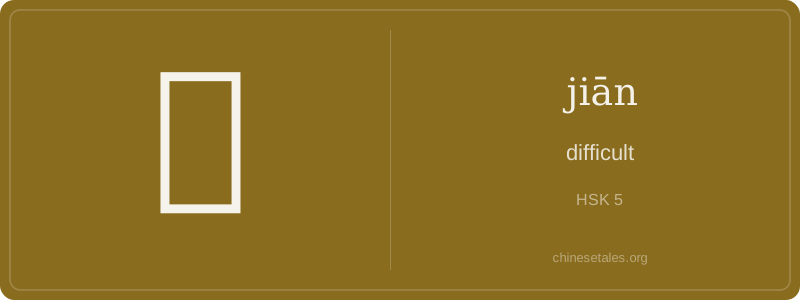
The earliest form of 艰 appears in bronze inscriptions as a compound: left side was 堅 (jiān, 'solid/hard'), originally depicting a person holding a halberd (戈) beside a wall (土) — symbolizing unyielding defense; right side was 又 (yòu), the 'again' radical, later simplified to 又 in modern script. Over centuries, 堅 lost its halberd and wall, collapsing into 堪 (kān), then further stylized into the top component of 艰 — a compressed, angular 'sturdy frame' above the 又. The 又 radical isn’t just decorative: it signals repetition, persistence — reinforcing the idea of *ongoing* difficulty.
This visual logic shaped its semantic evolution. In the *Zuo Zhuan*, 艰 described 'unrelenting siege conditions'; by the Tang, it broadened to moral hardship (e.g., 'a life of 艰贞' — steadfast virtue amid adversity). Its dual structure — upper part implying structural rigidity, lower part suggesting repeated action — perfectly captures 'difficulty that demands sustained effort'. Unlike characters born from nature (山, 水), 艰 is human-made: a linguistic monument to perseverance etched in strokes.
Imagine you’re hiking up a steep, rocky mountain path in Yunnan — no switchbacks, just sheer incline, your breath ragged, pack digging into your shoulders. That gut-level, physical *heaviness* — the kind that makes your muscles burn and your mind question every step — is exactly what 艰 (jiān) conveys. It’s not just 'hard' like a tough math problem; it’s arduous, grueling, historically layered difficulty — often involving endurance, sacrifice, or systemic barriers. Think of China’s ‘hard-won’ reforms, wartime resilience, or decades-long scientific breakthroughs: 艰 carries weight, dignity, and gravity.
Grammatically, 艰 rarely stands alone. It’s almost always in compounds (like 艰巨 or 艰苦), where it intensifies meaning — never used predicatively like 'This is jiān!' You’ll never say *Tā hěn jiān* (✗); instead, you say *Tā de jīnglì hěn jiānkǔ* (✓). It pairs powerfully with adjectives (艰深, 艰涩) or nouns (艰辛, 艰险), but never functions as a verb or standalone adjective — a classic HSK 5 trap for learners who overgeneralize from English 'difficult'.
Culturally, 艰 appears in solemn, aspirational contexts: national slogans (艰苦奋斗), historical narratives (长征的艰辛), or moral praise (他一生艰苦朴素). It implies nobility in struggle — unlike 苦 (kǔ), which can be raw suffering, 艰 suggests purposeful, socially recognized hardship. Learners often misapply it to everyday inconveniences ('The Wi-Fi is 艰!') — but that’s like calling a flat tire 'heroic'. Reserve it for trials that test character, not convenience.