盖
Character Story & Explanation
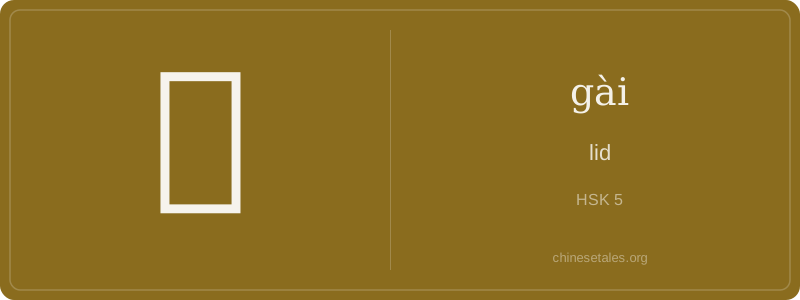
The earliest form of 盖, found on Warring States bamboo slips, was a vivid pictograph: a rounded vessel (皿) topped by a curved, overlapping shape — like a domed lid resting firmly on a bowl. Over time, the lid evolved into the top component — the grass radical 艹 (cǎo) — not because it’s botanical, but because scribes stylized the dome’s curves into three horizontal strokes resembling grass. Below it, 去 (qù, 'to go') was added phonetically, while the base remained 皿 (vessel), anchoring the meaning. By the Han dynasty, the structure solidified into today’s 11-stroke form: 艹 + 去 + 皿 — a lid (top), movement toward closure (middle), and container (base).
This visual logic shaped its semantic journey: from concrete 'lid' in the *Book of Songs* (‘the pot’s lid steams with fragrance’) to abstract 'to cover' in classical texts like *Mencius*, where moral influence is said to ‘cover all under heaven’ (盖天下). Even Confucius used 盖 cautiously — in the *Analects*, he says 盖有不知而作之者 (gài yǒu bù zhī ér zuò zhī zhě), using 盖 as a softening particle meaning ‘perhaps’ — a grammatical twist born from the idea of ‘covering over uncertainty’. The character’s very shape whispers: something is placed deliberately atop something else — whether clay, truth, or authority.
Think of 盖 (gài) as the quiet guardian of containment — not just a physical lid, but anything that seals, covers, or tops off. Its core feeling is *closure with intention*: a teapot lid fits snugly, a roof盖s a house, and even a signature盖s a document — all imply deliberate placement and authority. You’ll rarely see it alone; it’s usually part of compounds (like 盖子 or 覆盖) or functions as a verb meaning 'to cover' or 'to seal' — e.g., 他盖上了盒子 (tā gài shàng le hé zi), where 上 signals completion of the covering action.
Grammatically, it’s versatile but tricky: as a verb, it often pairs with aspect particles (了, 着, 过) and directional complements (上, 下, 住); as a noun, it almost always appears with 的 or as part of a compound (you’d say 盒子的盖, not *盖的盒子). Learners mistakenly use it like English ‘cover’ intransitively ('the book covers well'), but in Chinese, 盖 must act upon something — there’s always an object being sealed, concealed, or crowned.
Culturally, 盖 carries subtle weight: stamping a document with your seal (盖章) isn’t bureaucracy — it’s a ritual of commitment, echoing imperial edicts stamped with the emperor’s jade seal. A common mistake? Confusing it with 盖 (gě) — the rare surname reading — or mispronouncing it as gāi (a nonexistent tone). Also, don’t forget its radical 皿 (vessel) — a constant visual reminder: this character belongs to the world of containers, not abstract concepts.