蔬
Character Story & Explanation
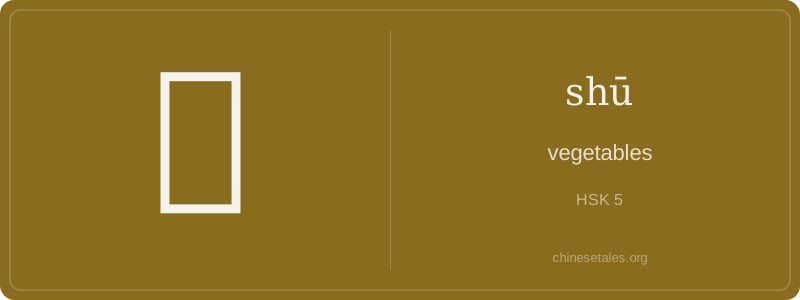
The earliest form of 蔬 appears in seal script (c. 3rd century BCE), built from 艹 (grass radical) on top and 疏 (shū, 'to clear, space out') below — not as a phonetic placeholder, but as a meaningful clue. The lower part originally depicted bamboo strips being separated and organized, suggesting 'carefully tended, orderly growth.' Over centuries, the bamboo radical ⺮ simplified into the 'spaced-out' structure we see today, while the grass head stayed firm — visually anchoring the character in the plant world. Stroke by stroke, the modern 15-stroke form crystallized: three horizontal grass strokes (艹), then the clean, open frame of 疏 — nine strokes below, echoing cultivation, spacing, and harvest rhythm.
This wasn’t just 'green things' — classical texts like the *Qimin Yaoshu* (540 CE agricultural manual) used 蔬 specifically for *intentionally grown, non-grain edible plants*, distinguishing them from wild herbs (草) or grains (穀). By the Tang dynasty, 蔬 had become synonymous with cultivated virtue: just as vegetables require patience, spacing, and care, so too does moral development. Poets like Du Fu praised 'freshly picked 蔬' not for taste alone, but as symbols of humble integrity — a visual pun where well-spaced strokes mirrored well-ordered life.
Think of 蔬 (shū) not just as 'vegetables' but as the *cultivated, leafy, garden-fresh* kind — the kind you’d find in a traditional Chinese market stall, not frozen peas in a bag. It’s a formal, literary word: you’ll see it on restaurant menus ('sù shí shū cài'), health articles, or government nutrition guidelines, but rarely in casual speech (where people say 菜 cài). Its core feeling is wholesome, natural, and slightly refined — like the difference between 'produce' and 'greens' in English.
Grammatically, 蔬 almost always appears in compounds (e.g., 蔬菜 shūcài, 蔬果 shūguǒ), never alone. You wouldn’t say *‘我吃蔬’ — that’s ungrammatical. It’s a bound morpheme: elegant, precise, and stubbornly dependent. Even in HSK 5 writing tasks, learners mistakenly use it solo; remember: 蔬 needs company — usually 菜, 果, or 菜园. Also, note its tone: shū (first tone), not shǔ or shù — mispronouncing it could land you at a ‘tree’ (树) or ‘count’ (数) instead of your stir-fry!
Culturally, 蔬 carries echoes of agrarian values — it’s tied to harmony with nature, seasonal eating, and medicinal food theory (e.g., ‘清热解毒的蔬’ — vegetables that clear heat and detoxify). Learners often overuse it trying to sound sophisticated, but native speakers default to 菜 for everyday contexts. Bonus trap: it’s easily miswritten as 蔬 vs. 疏 (shū, 'sparse') — same sound, wildly different meaning. One stroke (the 'thorn' ⺮ vs. 'grass' 艹) changes your salad into an empty field.