蛇
Character Story & Explanation
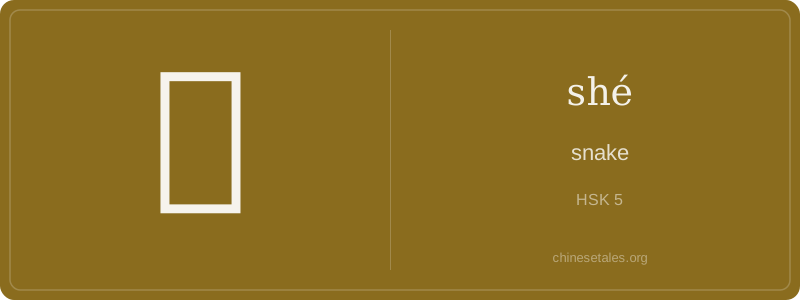
The earliest form of 蛇 appears in oracle bone inscriptions as a highly stylized, undulating line with a distinct head—sometimes with a dot for an eye or a forked tongue. Over centuries, the top simplified into the radical 虫 (chóng, ‘insect/creeping creature’), anchoring it taxonomically, while the lower part evolved from a sinuous curve into today’s 又 + 丶 + 乚 — a visual echo of a coiled body with tail flicking upward. This wasn’t abstract art: every stroke preserved the essence of motion—no rigid angles, only bends and flow.
By the Warring States period, 蛇 appeared in texts like the *Zhuangzi*, where it represented effortless action (wu wei): ‘The snake moves without legs, yet goes far.’ In the *Shuowen Jiezi* (121 CE), Xu Shen defined it as ‘a long-bodied, scale-covered creature that sheds its skin,’ highlighting regeneration over fear. Its visual rhythm—curving down then up—mirrors how ancient scribes saw it: not as a threat, but as nature’s perfect, self-renewing loop.
At its heart, 蛇 (shé) isn’t just a zoological label—it’s a creature of movement, mystery, and subtle power in Chinese thought. Unlike English ‘snake’, which often carries biblical or fearful connotations, 蛇 evokes fluidity, transformation, and quiet intelligence—think of the agile, sinuous motion captured in its curved strokes. The character feels alive: it’s rarely used alone as a noun in speech (you’d say 一条蛇 yī tiáo shé, not just 蛇), but it thrives in compounds, idioms, and metaphors.
Grammatically, 蛇 is almost always a noun—but watch out: it *never* takes the measure word 个 (gè). That’s a classic HSK 5 trap! Use 条 (tiáo) for long, flexible things: 一条蛇 (yī tiáo shé), not *一个蛇. Also, it’s common in similes (e.g., 蛇一样滑 shé yíyàng huá — 'slippery as a snake') and in the zodiac (属蛇 shǔ shé — 'born in the Year of the Snake'), where it implies charm, intuition, and strategic patience—not danger.
Culturally, 蛇 avoids simplistic ‘good vs. evil’ framing. In Daoist cosmology, it symbolizes renewal (shedding skin), and in folklore, white snakes like Bai Suzhen are wise, loyal, and tragically human. Learners often mispronounce it as ‘she’ with flat tone—remember: it’s shé (2nd tone, rising), like saying ‘she?’ with surprise. And never confuse it with the verb 折 (zhé/shé)—homophone confusion here can turn ‘a snake slithers’ into ‘a branch breaks’!