蜂
Character Story & Explanation
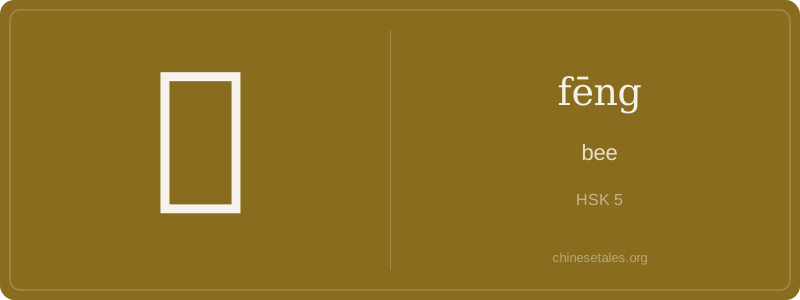
The earliest form of 蜂 appears in Warring States bamboo slips as a simplified pictograph: a curved, segmented body (虫) fused with a stylized ‘mountain peak’ shape (峰’s precursor), representing both the insect’s slender, tapered abdomen and its tendency to hover high — near flowers atop stems or cliffside hives. Over centuries, the left side standardized into the modern 虫 radical (six strokes: 丨 一 丨 丶 丶), while the right evolved from a jagged peak symbol into today’s 峰-like structure (seven strokes: ノ 丨 一 一 一 丨), preserving the original phonetic clue and visual echo of upward movement.
This dual-rooted design wasn’t accidental: classical texts like the *Erya* (3rd c. BCE) already classified 蜂 under ‘insects that build combs and sting’, highlighting its social nature and defensive power. By the Tang dynasty, poets like Du Fu used 蜂 metaphorically — ‘蜂蝶纷纷过墙去’ (bees and butterflies fluttering over the wall) — linking its flight to transience and delicate beauty. The character’s enduring form reflects a rare harmony: a precise zoological term shaped by phonetics, aesthetics, and ancient observation — where sound, shape, and meaning all hum in unison.
At its core, 蜂 (fēng) isn’t just ‘bee’ — it’s a buzzing embodiment of industriousness, collective energy, and gentle danger. The character radiates *life-in-motion*: the left-side 虫 (chóng, ‘insect’) grounds it in the animal kingdom, while the right-side 峰 (fēng, ‘peak, summit’) — pronounced identically — lends both phonetic support and a subtle, poetic resonance: bees rise like tiny mountaineers, swarming toward nectar-rich heights. This duality makes 蜂 feel more vivid than generic insect terms — it’s specific, sonorous, and slightly majestic.
Grammatically, 蜂 behaves like most concrete nouns: it’s rarely used alone in speech (you’ll almost always say 蜜蜂 mìfēng, ‘honey bee’, or 马蜂 mǎfēng, ‘hornet’). It never takes aspect markers like 了 or 过 directly — you’d say ‘蜜蜂飞走了’ (mìfēng fēi zǒu le), not ‘蜂了’. Learners often overgeneralize and drop 蜜, saying *‘蜂在采蜜’ — which sounds abrupt and textbook-y; native speakers instinctively prefer the full compound unless context is crystal clear (e.g., in poetry or scientific labels).
Culturally, 蜂 carries warm connotations of diligence (‘like bees’ — 勤劳如蜂) and community, but also sharp caution: the idiom 蜂拥而至 (fēng yōng ér zhì, ‘swarm to arrive’) evokes overwhelming, sometimes chaotic crowds. A classic learner trap? Confusing 蜂 with 风 (fēng, ‘wind’) — homophone peril! Writing 蜂 instead of 风 in ‘春风’ (chūn fēng) yields ‘spring bee’ — an absurd, giggling error that instantly flags non-native handwriting.