血
Character Story & Explanation
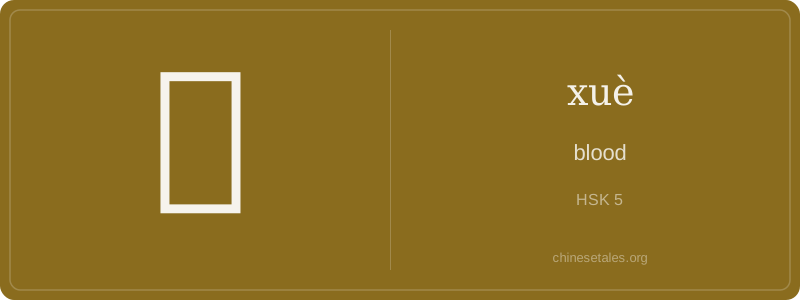
The earliest form of 血 appears on Shang dynasty oracle bones as a simple pictograph: a square or oval container (like a ritual bronze ding) with three dots inside—representing blood droplets collected during sacrificial rites. By the Zhou bronze script, the container became more stylized—a boxy frame—and the dots evolved into three short horizontal strokes. In seal script, the top transformed into a lid-like cover (the modern top stroke), while the interior strokes stabilized into the three dashes we see today. The bottom ‘皿’ (vessel) radical was later dropped in clerical script, leaving only the abstracted vessel outline + three drops—now the sleek, six-stroke 血 we write. Its shape is literally ‘blood-in-a-bowl’: ancient China viewed blood as sacred, ritually contained, not freely flowing.
This vessel-and-drops motif persisted through history: Confucius wrote in the Analects (3.17) about ‘blood sacrifices’ (血祭) to honor ancestors, reinforcing 血 as a conduit between human and divine. In Tang poetry, Du Fu described war wounds with ‘blood soaking the earth’ (血浸地), using 血 for visceral impact—not clinical precision. Even today, the character’s design whispers its origin: those three horizontal strokes aren’t random—they’re the *drops*, frozen in time, reminding us that every drop of blood was once offered in reverence, not just pumped by the heart.
At its core, 血 (xuè) isn’t just ‘blood’ as a biological fluid—it’s a visceral, life-force symbol in Chinese: think lineage (血脉), sacrifice (献血), or raw emotion (热血). Unlike English, where ‘blood’ is mostly literal or metaphorical, 血 carries grammatical weight: it’s almost never used alone in speech (you’d say 血液 or 鲜血, not just 血), and it appears in fixed compounds like 血压 (blood pressure) or 血型 (blood type)—never *xuè yā* as a free phrase. Learners often mispronounce it as ‘xiě’ (a common error from misreading the tone mark), but the correct HSK 5 reading is always xuè—except in rare classical compounds like 血淋淋 (xiě lín lín), where the variant tone signals gory vividness.
Grammatically, 血 functions as a noun that resists modification—you won’t say *hěn xuè* (‘very blood’); instead, it partners with measure words (一滴血 yī dī xuè — ‘a drop of blood’) or appears in idioms like 血浓于水 (xuè nóng yú shuǐ — ‘blood is thicker than water’). It also forms verb-like compounds: 献血 (xiàn xuè, ‘donate blood’) uses 血 as an object, not a verb root—so no ‘to blood’ exists in Chinese. This noun-anchored behavior trips up learners who expect English-style derivations.
Culturally, 血 evokes ancestral continuity (祖宗的血, ‘ancestors’ blood’) and moral intensity: 热血青年 (rè xuè qīng nián, ‘ardent youth’) implies passionate idealism—not temperature. A classic mistake? Using 血 alone where context demands 血液 (xuè yè, formal ‘blood’) or 血水 (xuè shuǐ, ‘blood-water’, i.e., diluted blood)—like in medical reports vs. literary descriptions. Also, avoid writing 血 as a radical in other characters; it’s a standalone radical (no ‘blood-related’ sub-radicals like in 氵)—making it one of only ~20 self-radical characters in modern use.