衡
Character Story & Explanation
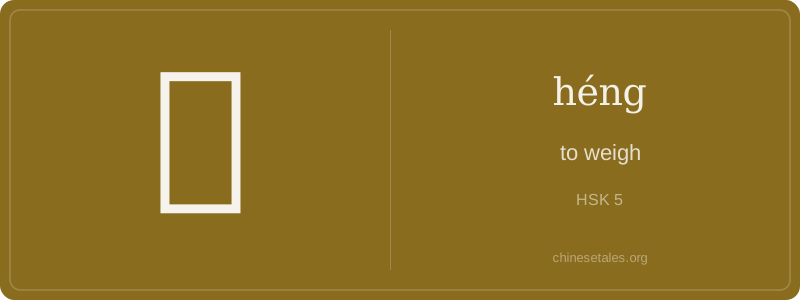
The earliest form of 衡 appears on Warring States bamboo slips as a complex pictograph: a horizontal beam (represented by two parallel lines) suspended from a central pivot, with weights hanging at both ends—and crucially, the left side included a walking-related element (the ancestor of 行), suggesting movement *along a measured path*. Over centuries, the beam simplified into the top component (a flattened ‘U’ shape + a horizontal stroke), the pivot became the middle ‘big’ (大) shape, and the weights evolved into the right-side ‘fish’-like component (originally a stylized weight symbol, later misinterpreted as 鱼 yú but actually unrelated). By the Han dynasty, it had stabilized into today’s 16-stroke form with 行 on the left anchoring the concept of orderly, traversable balance.
This visual logic shaped its meaning: not just ‘to weigh’, but ‘to judge with impartial motion’—as if justice itself walks a measured road. In the *Zuo Zhuan*, ministers are praised for their ability to 衡 事 (héng shì, ‘weigh matters’), implying deliberation with moral gravity. Even today, the left-side 行 reminds us that balance isn’t static—it’s dynamic, practiced, and requires *movement through principle*. The character doesn’t depict a still scale; it depicts the *act of walking the line* between extremes—a subtle but profound shift from object to ethic.
At its heart, 衡 isn’t just about weighing objects on a scale—it’s about *measuring balance*: fairness, proportion, and equilibrium in relationships, policy, or even cosmic order. The character carries quiet authority; when you see it in words like 平衡 (píng héng, 'balance') or 衡量 (héng liáng, 'to assess'), it signals thoughtful, calibrated judgment—not quick guesses. It’s never used alone as a verb in modern speech; you’ll always see it paired (e.g., 衡量、权衡), often with another verb or in compound nouns.
Grammatically, 衡 almost always appears in formal or abstract contexts—never for kitchen scales or grocery weigh-ins (that’s 称 chēng). Learners mistakenly try to say *‘I weigh 65 kg’* with 衡—nope! That’s 称 or 重. Instead, 衡 shows up in essays, news reports, and policy debates: ‘We must weigh the risks and benefits’ → 必须权衡利弊 (bì xū quán héng lì bì). Notice how it partners with 权 (quán, ‘to consider’) or 量 (liáng, ‘to measure’) — it’s a team player that refuses to go solo.
Culturally, 衡 echoes ancient Chinese cosmology: the ideal ruler ‘balances’ yin and yang, rewards and punishments, growth and restraint. Confucius praised the ‘balanced person’ (中庸 zhōng yōng), and 衡 quietly underpins that ideal. A common slip? Writing 衡 instead of 横 (héng, ‘horizontal’)—same sound, totally different meaning and shape. Remember: 衡 has 行 (háng, ‘road/row’) on the left—this is a *path to fairness*, not just a line across the page.