订
Character Story & Explanation
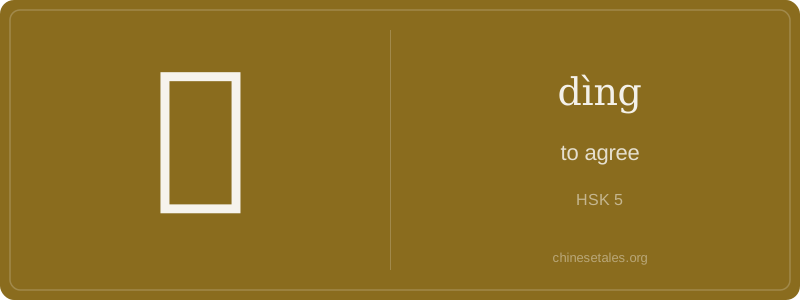
The earliest form of 订 appears in bronze inscriptions as a combination of 言 (speech, promise) and 丁 (dīng, originally a pictograph of a nail or peg — later phonetic). In oracle bone script, 丁 looked like a sturdy vertical stroke with a horizontal bar — symbolizing something driven firmly into place. Over time, the 言 radical simplified to 讠 (the ‘speech’ component on the left), while 丁 retained its sharp, anchoring shape: four clean strokes — one dot, one horizontal, one vertical, one hook — evoking the act of hammering agreement into reality.
This visual metaphor held strong through history: in the Shuōwén Jiězì (121 CE), 订 was defined as ‘to settle, to fix, to determine’, emphasizing resolution after discussion. By the Tang dynasty, it appeared in texts like Bai Juyi’s poems referring to ‘订正’ (dìngzhèng, correcting errors) — literally ‘fixing words’. The character never wavered from its core idea: speech + solidity = binding decision. Even today, every time you 订 a hotel room, you’re echoing that ancient image — driving a linguistic nail into the future.
At its heart, 订 (dìng) is about binding agreements — not just signing a contract, but the moment two parties lock in mutual commitment. Think of it as the Chinese verb for 'sealing the deal': it implies intentionality, formality, and forward motion — you don’t ‘订’ something vague; you订 a magazine, a flight, a marriage, or a textbook. It’s inherently future-oriented: what you 订 hasn’t happened yet, but it’s now guaranteed to happen.
Grammatically, 订 is almost always transitive and takes a concrete, countable object — never abstract concepts like ‘peace’ or ‘friendship’ (use 达成 or 建立 instead). You can say 订机票 (book a ticket), but never *订友谊. Also, it rarely stands alone: you’ll almost always see it in compounds like 预订 (yùdìng, reserve in advance) or 订阅 (dìngyuè, subscribe). A classic learner mistake? Using 订 where 约 (yuē, to make an appointment) fits better — e.g., saying *订个见面 instead of 约个见面 (‘make a meeting’).
Culturally, 订 carries subtle weight: in traditional contexts, 订婚 (dìng hūn) isn’t just ‘getting engaged’ — it’s the formal exchange of betrothal gifts, witnessed by elders, marking irreversible social commitment. Even today, 订 signals seriousness: a 订制 (dìngzhì) suit isn’t just ‘made-to-order’ — it’s bespoke craftsmanship with your name on the tag. Learners often miss this gravity and use it too casually — like saying 我订了咖啡 when ordering at a café (use 点了 instead). Remember: 订 means ‘I’ve locked it in’, not ‘I’ve asked for it’.