训
Character Story & Explanation
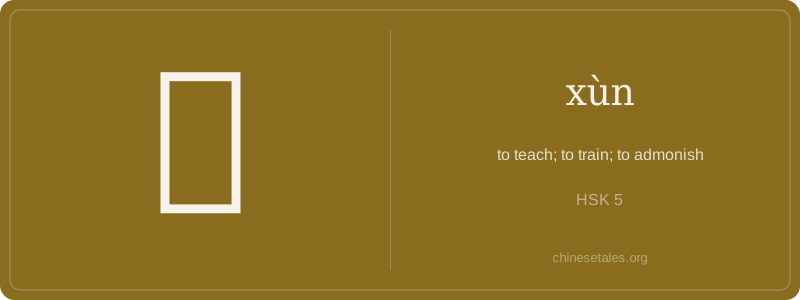
The earliest form of 训 appears in bronze inscriptions (c. 1000 BCE) as a compound: the left side was 言 (yán, ‘speech’) — drawn as a mouth with a tongue — and the right was 川 (chuān), which originally depicted flowing water but here stood for *xūn*, an ancient phonetic element. Over centuries, 川 simplified into the elegant, three-stroke 丿丨一 shape we see today — not ‘water’ anymore, but pure sound-symbol. By the seal script era, the left became the modern 讠 radical (the abbreviated ‘speech’ radical), and the right solidified into the clean, descending stroke + horizontal + dot structure — five strokes total, embodying crisp, directed utterance.
This visual evolution mirrors its semantic journey: from early Western Zhou inscriptions where 训 meant ‘to expound the meaning of ancient texts’, to Han dynasty usage in classics like the *Book of Rites*, where it denoted ‘authoritative interpretation handed down by sages’. The character never meant casual advice — it was always tied to transmitting received wisdom, correcting deviation, and aligning action with principle. Its sharp, minimal strokes reflect that precision: no flourish, no ambiguity — just speech with purpose and weight.
At its heart, 训 (xùn) carries the weight of authoritative guidance—not gentle suggestion, but purposeful shaping of behavior or understanding. It’s the word for ‘training’ a dog, ‘admonishing’ a student who missed a deadline, or ‘teaching’ classical texts in a rigorous academy. Unlike 教 (jiāo), which is neutral and broad (‘to teach’), 训 implies hierarchy, expectation, and corrective intent: someone with authority (a teacher, parent, or elder) imparting standards—not just facts, but values and conduct.
Grammatically, 训 appears mostly in compound words (like 训练 or 教训), rarely as a standalone verb in modern speech. You won’t say *‘wǒ xùn tā’* (I训 him) alone—it sounds archaic or overly stern. Instead, it thrives in set phrases: 训练 (xùnliàn, ‘to train’), 受训 (shòu xùn, ‘to undergo training’), or 教训 (jiàoxùn, ‘lesson/moral warning’). Learners often overuse it as a direct verb like ‘teach’, missing this nuance—and accidentally sounding like a Ming-dynasty magistrate scolding a peasant.
Culturally, 训 reflects Confucian pedagogy: learning isn’t passive absorption, but disciplined internalization under guidance. The character even appears in imperial edicts (e.g., 谕训 yùxùn, ‘imperial instruction’) and family mottoes—signaling that moral formation is inseparable from language itself. A common mistake? Confusing it with 讲 (jiǎng, ‘to lecture’) or 论 (lùn, ‘to discuss’): those are dialogic; 训 is unidirectional, grounded in duty, not debate.