访
Character Story & Explanation
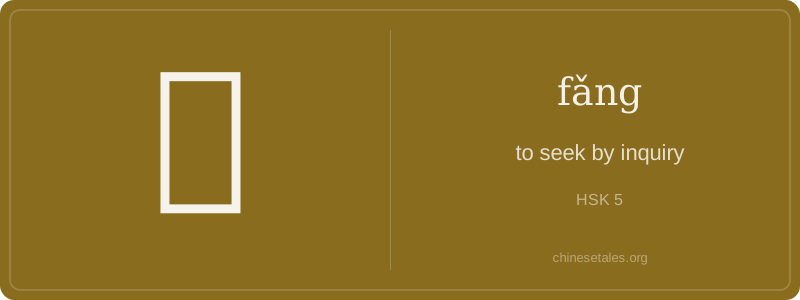
The earliest form of 访 appears in bronze inscriptions as a combination of 言 (yán, ‘speech’, later simplified to 讠) and 方 (fāng, ‘direction’ or ‘region’). The original pictograph wasn’t a person walking — it was a stylized representation of someone speaking *toward a specific place*: mouth open, words directed outward, aiming at a location. Over centuries, the 言 radical shrank into its modern two-stroke 讠 form on the left, while 方 retained its angular, balanced shape on the right — six strokes total, mirroring the precision and directionality embedded in the act of seeking through speech.
This directional speech concept deepened in classical usage. In the Book of Rites (Lǐjì), 访 describes rulers ‘inquiring of the people’ — not just listening, but actively turning their attention and questions toward a source of wisdom. By the Tang dynasty, 访 became standard in literary travel writing: poets didn’t merely ‘go to’ mountains — they 访名山 (fǎng míngshān, ‘seek out famed mountains’), implying reverence and deliberate pursuit. The character’s visual balance — speech + direction — never wavered: every time you write 访, you’re drawing intentionality made visible.
At its heart, 访 (fǎng) isn’t just ‘to visit’ — it’s ‘to seek by inquiry’. That subtle distinction is everything. Think of a detective knocking on doors, a scholar tracking down an old manuscript, or a journalist pursuing a lead: there’s intention, effort, and dialogue involved. It’s not passive presence; it’s active pursuit *through speech*. That’s why 访 always implies purposeful contact — you don’t ‘访’ your neighbor for small talk, but you might 访问 their opinion on neighborhood policy.
Grammatically, 访 is almost never used alone. It appears in compounds like 访问 (fǎngwèn, to interview/visit officially) or 探访 (tànfǎng, to visit with concern or curiosity). As a verb, it requires an object or clear context: 我们将访问上海 (Wǒmen jiāng fǎngwèn Shànghǎi — We will visit Shanghai *for official purposes*). Learners often mistakenly use it like the English ‘visit’ in casual contexts — but that’s where 找 (zhǎo), 去 (qù), or even 看 (kàn) belong instead.
Culturally, 访 carries a quiet dignity — it’s the verb of diplomacy, scholarship, and respectful outreach. In classical texts, 访 appears in phrases like ‘咨询访问’ (zīxún fǎngwèn — consultative visit), underscoring its link to knowledge exchange. A common mistake? Using 访 when you mean ‘to look up’ (查 chá) or ‘to search online’ (搜索 sōusuǒ). Remember: if no conversation or human interaction is implied, 访 probably isn’t the right choice.